How Mexico’s Protected Natural Areas Conserve Biodiversity
Learn how many protected natural areas Mexico has, how they are classified, what they do for biodiversity and how to visit and support them.
By Global Lemon Team ·
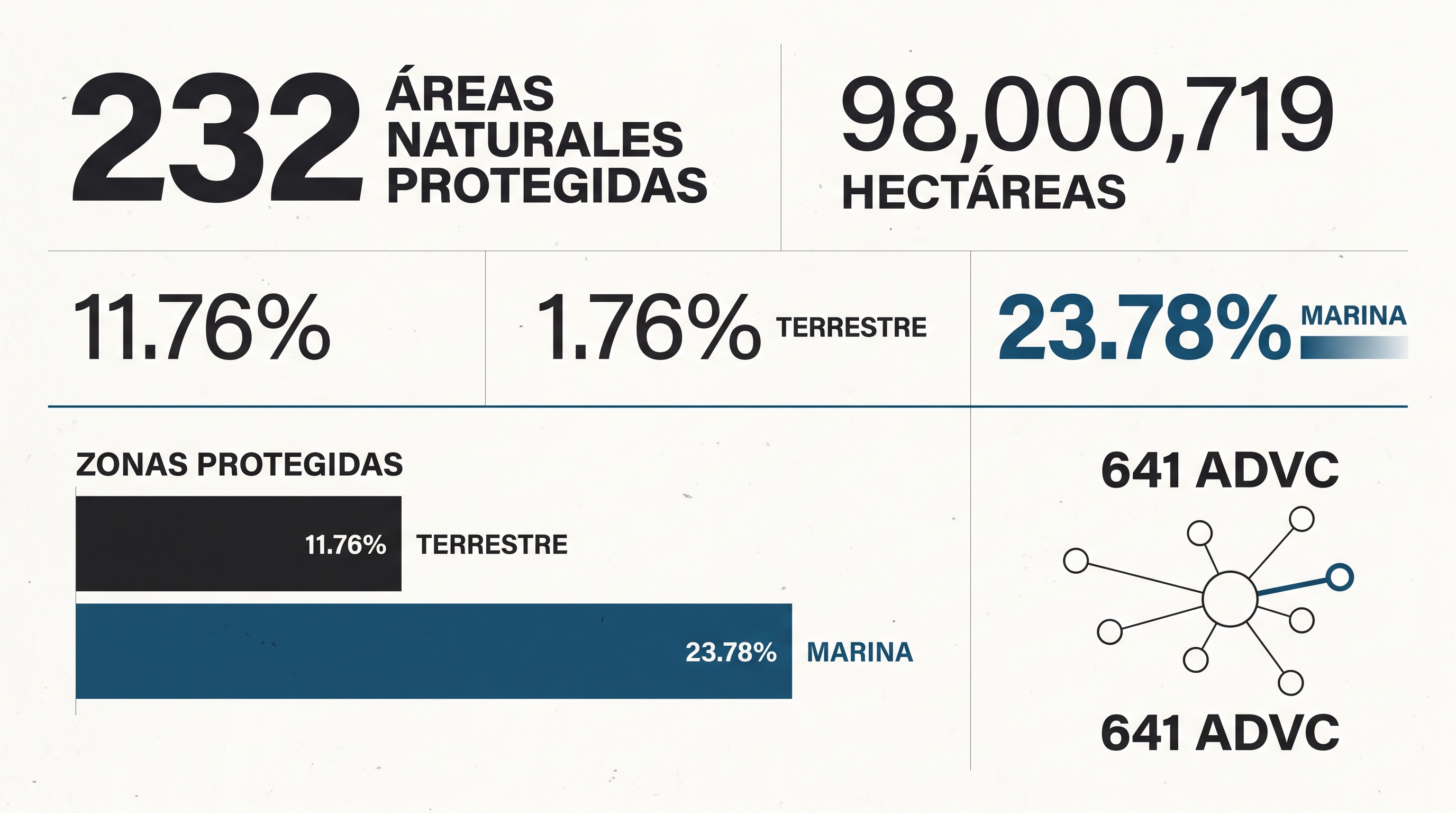
At a glance Mexico has 232 federally designated protected natural areas (ANPs) covering 98,000,719 hectares: 11.76% of Mexico’s land area and 23.78% of its marine area, according to official figures from the National Commission of Protected Natural Areas (CONANP). Mexico’s General Law of Ecological Balance and Environmental Protection (LGEEPA) recognizes seven federal categories: biosphere reserves, national parks, natural monuments, natural resource protection areas, flora and fauna protection areas, sanctuaries, and areas voluntarily designated for conservation (ADVCs). There are 641 certified ADVCs, most of them belonging to communities and ejidos, or communal landholdings.
Mexico is one of the world’s megadiverse countries. A substantial share of that natural wealth has official protection: 232 federally designated areas covering 98,000,719 hectares, nearly twice the area of Spain [1].
You may have seen a figure of 182. It comes from sources published between 2015 and 2018 and is now out of date. This guide gives the official count and shows where it comes from.
It also explains why the totals differ and which categories the law recognizes. Read on for practical information about visiting ten distinctive sites, the funding pressures facing protected areas, and the community-led conservation model known as the ADVC.
What people are saying
“Mexico’s National Commission of Protected Natural Areas manages 232 federally protected natural areas.” — CONANP, via X
“Between 2018 and 2023, 21 new protected natural areas were designated.” — Government of Mexico, via X
“Did you know Mexico City has eight national parks? These green spaces help the city breathe and provide a refuge for biodiversity.” — SEDEMA CDMX, via X
Three questions keep coming up on social media:
- Which count is right, 182 or 232?
- How can I visit without causing harm?
- How well can these areas be protected after budget cuts?
This guide addresses all three.
How many protected natural areas does Mexico have? The official count
CONANP manages 232 federally designated protected natural areas covering 98,000,719 hectares. Of that total, 23,096,563.19 hectares are on land (11.76% of Mexico’s land area) and 74,904,155.39 hectares are at sea (23.78% of its marine area) [1].
An important distinction: more than three quarters of the protected area, around 76%, is at sea. Even a large overall total can leave many temperate and tropical forests outside the protected system. Few guides explain this distinction.
Many websites quote 182 because they repeat figures from 2015–2018. The system has expanded since then. According to the Mexican government, 21 new areas were designated between 2018 and 2023 alone. CONABIO’s metadata, updated through July 2025, identifies each federal protected area, its management category, size, and most recent decree [2].
You may also see different totals, such as roughly 99 million hectares. Differences usually reflect the reporting date or the inclusion of other types of conservation areas. When citing a figure, include the date and source.
Official figures for September 2024 give the following breakdown.
| Category | Number | Area (ha) |
|---|---|---|
| Biosphere Reserves | 48 | 64,033,711 |
| National parks | 79 | 21,679,414 |
| Flora and Fauna Protection Areas | 57 | — |
| Sanctuaries | 28 | 155,488 |
| Natural resource protection areas | 15 | — |
| Natural Monuments | 5 | 16,269 |
| Total | 232 | 98,000,719 |
The six category counts add up to exactly 232. Subtracting the known areas of the other categories from the total indicates that flora and fauna protection areas and natural resource protection areas together cover about 12.1 million hectares. That breakdown reflects the reporting date and can change with each decree or amendment. Check it against CONANP’s latest figures.
Federal designation by decree is only one form of protection. States and municipalities also have protected areas. The seventh federal category covers areas voluntarily designated for conservation, or ADVCs. There are 641 certified ADVCs, covering 1,410,003.27 hectares in 30 federal entities [5].
The legal definition appears in Article 3, section II, of the General Law of Ecological Balance and Environmental Protection (LGEEPA). Article 44 adds that the protected-area regime applies to places whose original environments have not been significantly altered or that require preservation and restoration [3].
Ten of Mexico’s best-known protected areas and how to visit them
These ten protected areas combine ecological importance, international recognition, and opportunities for visitors. Admission fees are estimates and change each year. Confirm them with the site office before traveling.
| Protected area | Category | State | Admission (MXN) | Visitor highlight |
|---|---|---|---|---|
| El Vizcaíno | Biosphere Reserve | Baja California Sur | — | Gray whale watching |
| Revillagigedo | National Park | Colima (offshore islands) | — | Diving in North America’s largest fully protected marine area |
| Arrecife de Puerto Morelos | National Park | Quintana Roo | $125 | Snorkeling (14 activities, 6 a.m.–9 p.m.) |
| Arrecife Alacranes | National Park | Yucatán | $750 | Diving |
| Alto Golfo de California | Biosphere Reserve | Sonora / Baja California | $95 | Desert and marine landscapes |
| Desierto de los Leones | National Park | Mexico City | — | Mexico’s first protected natural area (1917) |
| Mariposa Monarca | Biosphere Reserve | Michoacán / State of Mexico | — | Wintering monarch butterflies |
| Sian Ka'an | Biosphere Reserve | Quintana Roo | — | UNESCO World Heritage Site |
| Cuatrociénegas | Flora and fauna protection area | Coahuila | — | Blue pools and stromatolites |
| La Primavera | Flora and fauna protection area | Jalisco | — | Forest bordering a Global Lemon project |
A common mix-up: El Vizcaíno covers 2,546,790.25 hectares and is often described as Mexico’s largest protected natural area. CONANP’s official list puts the Caribe Mexicano Biosphere Reserve at 5,754,055.36 hectares, more than twice that size. The country’s largest marine unit is the Pacífico Mexicano Profundo Biosphere Reserve [6].
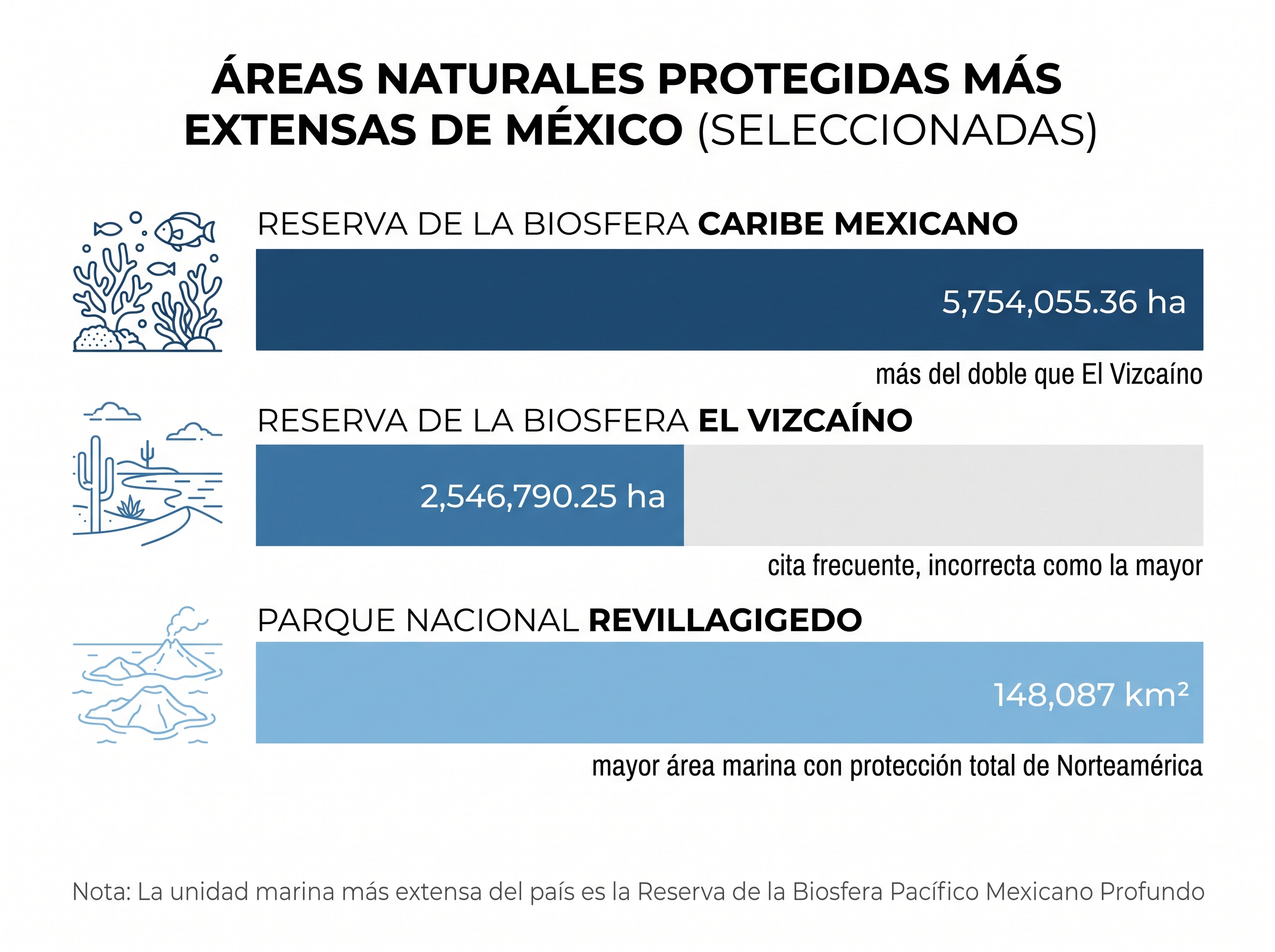
Revillagigedo was designated in November 2017. It covers 148,087 square kilometers and is North America’s largest fully protected marine area [6]. Because of its remote location, most visitors come on dive boats from Baja California Sur.
Desierto de los Leones became the country’s first protected natural area in 1917 and remains a national park. Its designation has lasted more than a century even as urban pressures around it have changed completely.
How to visit responsibly
- Read the site’s management plan before you travel. It explains which activities are permitted and which restrictions apply.
- Understand the zoning. Article 47 Bis of the LGEEPA distinguishes two types of zones [3]:
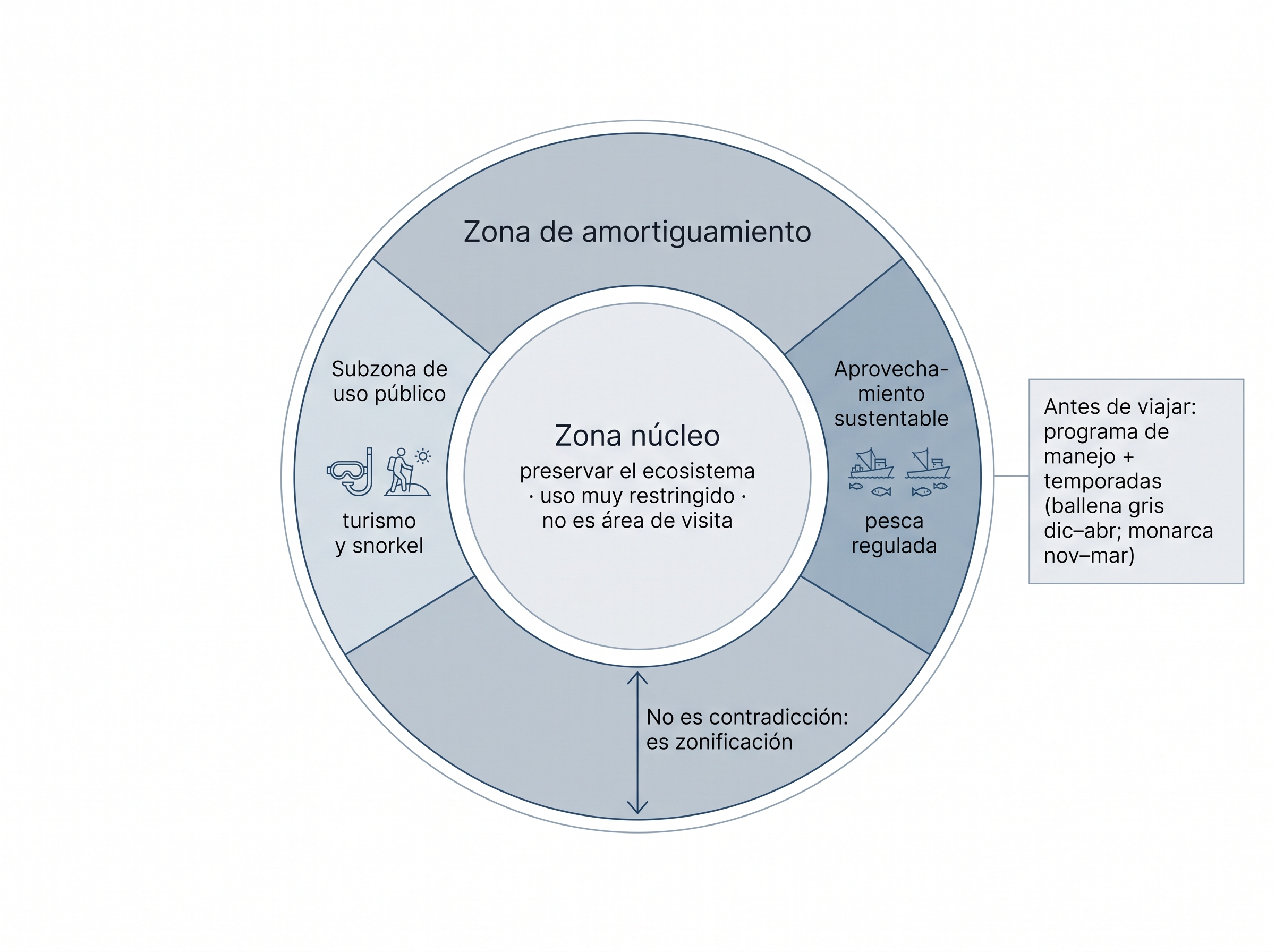
• Core zonesprotect the ecosystem and allow only very limited use. • Buffer zonescontain subzones for public access and sustainable use.
- Plan around wildlife seasons. Visitors can see gray whales in El Vizcaíno from December to April. Monarch butterflies overwinter in their sanctuaries from roughly November through March.
- Hire certified local guides. This keeps visitor spending in the hands of people who care for the area.
- Take your litter with you. Litter remains the most visible problem at heavily visited sites.
In marine national parks, the law provides for subzones where natural resources can be used sustainably [3]. At a protected reef, regulated fishing may therefore be allowed just meters from an area closed to the public. The difference reflects the zoning.
Conservation under pressure from funding cuts and deforestation
Mexico’s protected natural areas are operating with progressively less funding. CONANP’s budget fell from US$135 million in 2014 to about US$54 million in 2025, a drop of nearly 60%. The agency itself has said it needs more resources to carry out its work [7].
According to civil society analyses, the total budget for spending category 16 (Environment and Natural Resources) fell by 1.2% in 2026 compared with 2025.
The problem extends across the region. Governments in Latin America and the Caribbean spend around 0.006% of GDP on protected-area management, less than effective management requires [9].
In practice, this means:
- fewer park rangers per hectare,
- less monitoring in remote areas, and
- management plans that take years to update.
A decree gives a site legal protection. Effective protection on the ground also takes funding.
Meanwhile, pressure on forests continues. According to Global Nature Watch, natural forests accounted for 99% of Mexico’s tree cover loss from 2021 to 2025: 1.1 million hectares [8]. These are temperate and tropical forests that can take decades to recover, rather than commercial plantations.
Who is filling the gap? Civil society groups, companies with corporate social responsibility programs, and above all local communities. In its 2025 report, WWF Mexico says it strengthened 72 protected areas and reforested 21,651 hectares with support from 59 forest nurseries.
Effective conservation depends on more than government alone. Individuals and businesses can also take part.
ADVCs and community-led voluntary conservation
An ADVC is land held by an ejido, a community, or a private owner who chooses to have CONANP certify it for conservation. The LGEEPA recognizes these areas as a federal protected-area category. The official list from March 2026 records 641 certified ADVCs covering 1,410,003.27 hectares in 30 federal entities [5].
An ADVC begins with a decision by the landowner or the ejido assembly. The other six categories are established by decree. Voluntary designation gives the people living on the land the power to decide how to protect it.
Two routes to protection: decree or voluntary certification
| Option | Advantages | Limitations |
|---|---|---|
| Protected area designated by decree | Broad coverage (232 areas, about 98 million hectares), nationally recognized management categories defined by the LGEEPA. | Designation comes from government, and management relies on public funding. Without a budget, legal protection is hard to deliver on the ground. |
| ADVC (voluntary certification) | The ejido, community, or owner initiates the process. Anyone can verify the public CONANP certificate, including its number, area covered, and period of validity. | Together these areas cover 1,410,003.27 hectares in 30 federal entities. They cover less area overall and have fixed certification periods. The assembly’s decision must be recorded in its minutes. |
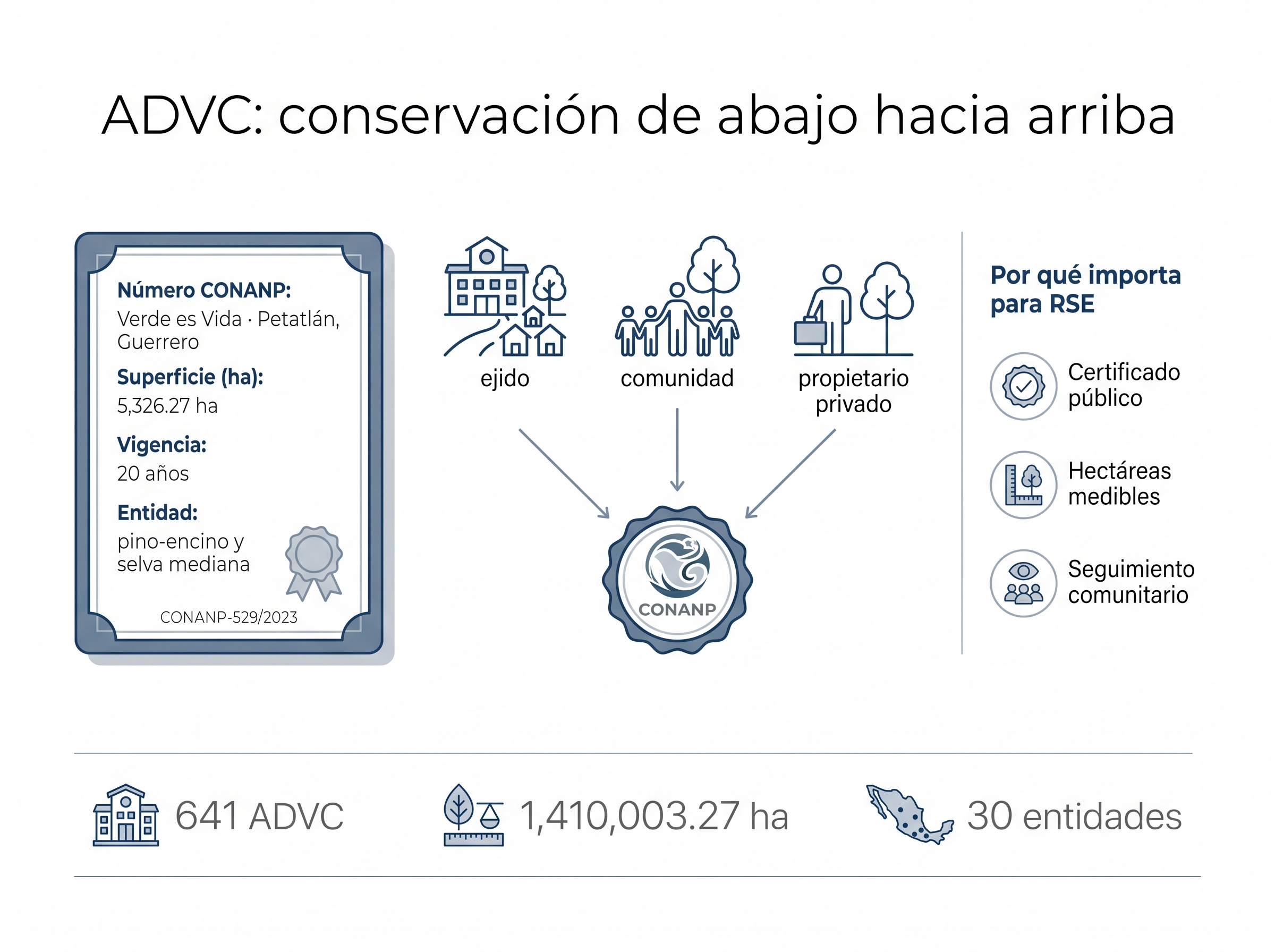
One entry in the official list is Verde es Vida in Petatlán, Guerrero. An ejido obtained certification for 5,326.27 hectares of common-use land with pine-oak forest and medium-height tropical forest. Certificate CONANP-529/2023 is valid for 20 years [5].
How certification works
- The ejido, community, or landowner applies to CONANP.
- The applicant provides evidence of ownership and area and describes the ecosystems on the property.
- The applicant defines a management strategy and permitted activities.
- CONANP issues a certificate for a specified period.
- The area is monitored for the duration of the certificate.
Practical advice for ejidos: put the decision to the assembly and record it in the minutes. That way the certification can continue even when the ejido’s leadership changes.
For corporate social responsibility managers: an ADVC provides something few environmental projects can offer: a public certificate whose number, area, and validity anyone can check in the official list.
At Global Lemon, we work with this model in our projects in Mexico:
- Patamban, Michoacán,
- Santa Rita Tlahuapan, Puebla;
- Bosque de la Primavera, Jalisco, which borders a federally protected natural area.
When the community makes the decision, the forest has a future.
Frequently asked questions about Mexico’s protected natural areas
What is a protected natural area in Mexico?
It is an area of Mexican territory under a special framework for protection, conservation, and restoration. Article 3, section II, of the LGEEPA provides the definition, and Article 44 explains which areas fall under the framework. A site may be federal, state, or municipal. Its rules depend on its category and management plan [3].
How many protected natural areas are there in Mexico today?
There are 232 federally designated protected natural areas covering 98,000,719 hectares, plus 641 certified ADVCs [1][5]. The figure of 182 dates to 2015–2018. Further designations have expanded the system since then.
What are the types of protected natural areas in Mexico?
The LGEEPA recognizes seven federal categories: biosphere reserves, national parks, natural monuments, natural resource protection areas, flora and fauna protection areas, sanctuaries, and ADVCs [3]. The first six are designated by decree. ADVCs are certified at the landowners’ request.
What is the largest protected natural area in Mexico?
The largest are marine areas. Pacífico Mexicano Profundo Biosphere Reserve is the country’s largest marine unit [6]. Caribe Mexicano, at 5,754,055.36 hectares, is larger than El Vizcaíno (2,546,790.25 ha), which is often mistakenly described as the largest.
What are the 10 most important protected natural areas in Mexico?
Some of the best known are El Vizcaíno, Revillagigedo, Arrecife de Puerto Morelos, Arrecife Alacranes, Alto Golfo de California, Desierto de los Leones, Mariposa Monarca, Sian Ka'an, Cuatrociénegas, and La Primavera. The table above lists their designations, locations, approximate fees, and visitor highlights.
Can I visit any part of a protected area?
No. Core zones allow only very restricted use. Tourism takes place mainly in public-use subzones within buffer zones. Check the site’s management plan before visiting.
What are ten examples of protected natural areas around the world?
Well-known examples include the Galápagos Islands (Ecuador), Yellowstone (United States), Serengeti (Tanzania), the Great Barrier Reef (Australia), Kruger (South Africa), Banff (Canada), Fiordland (New Zealand), Torres del Paine (Chile), Plitvice (Croatia), and Sian Ka'an (Mexico). Mexico’s place on the list reflects the country’s natural wealth.
Limits of protection and ways to help
A decree alone cannot guarantee protection. With a CONANP budget of roughly US$54 million in 2025 [7], many areas have only a small staff. Official figures change with each decree. Check the latest CONANP figures or CONABIO metadata [2]. Tourism does not take the place of active conservation, and the law restricts use of core zones [3].
To help beyond tourism, consider volunteering, donating to a project with verifiable results, or participating in a corporate social responsibility program that documents the area covered, community involvement, and follow-up.
Warning: this article provides general information and is not legal or financial advice. Before investing in carbon offsets or certifying land, consult environmental and legal specialists and ask for measurable results.
Conclusion
Mexico has 232 federally designated protected areas and roughly 98 million hectares under protection, within a legal framework of seven categories. These natural assets face real funding cuts. In 641 voluntarily designated areas, communities have chosen to protect their own land.
What to remember
- Cite 232 federally designated protected areas, and include the reporting date. The figure of 182 is out of date.
- Most of the protected area is at sea, while forests on land remain under pressure.
- Before visiting, check the management plan, respect zoning rules, and hire local guides.
- If your company wants to help, prioritize projects with public certificates and community monitoring.
We believe in planting, conserving, and growing alongside ejidos. Explore our projects in Patamban, Santa Rita Tlahuapan, and Bosque de la Primavera. To take part, join PLANTING or make a donation. Let’s do it together.
About the author
Global Lemon Team: we are a reforestation organization that works with ejido communities in Mexico. We write about conservation using verifiable data so you can make informed decisions.
Transparency statement
This article draws on official sources, including the LGEEPA published by Mexico’s Chamber of Deputies. Further sources appear in the references below. Global Lemon runs its own reforestation projects in Mexico, and links to those projects are identified as such.
References
[1] Valuing ecosystem services in Mexico’s federally protected natural areas (CONANP)
[2] Mexico’s federally protected natural areas, July 2025 (CONABIO)
[3] General Law of Ecological Balance and Environmental Protection (Chamber of Deputies)
[4] Valuing ecosystem services in Mexico’s federally protected natural areas (CONANP)
[5] Areas voluntarily designated for conservation, March 2026 list (CONANP)
[6] Mexico has North America’s largest nature reserve, in a place few would expect – Infobae
[7] Mexico’s protected areas face an uneven race against climate change (IPS Noticias)
[8] Mexico Deforestation Rates & Statistics | Global Nature Watch
[9] How much does it cost to conserve nature in Mexico? (Elementos, BUAP)
[10] Valuing ecosystem services in Mexico’s federally protected natural areas (CONANP)