Hydrogels in Reforestation: Storing Water Near the Roots
Potassium, sodium and Lluvia Sólida, with a nod to Frozen and no magic required.
By Global Lemon, Editorial team ·
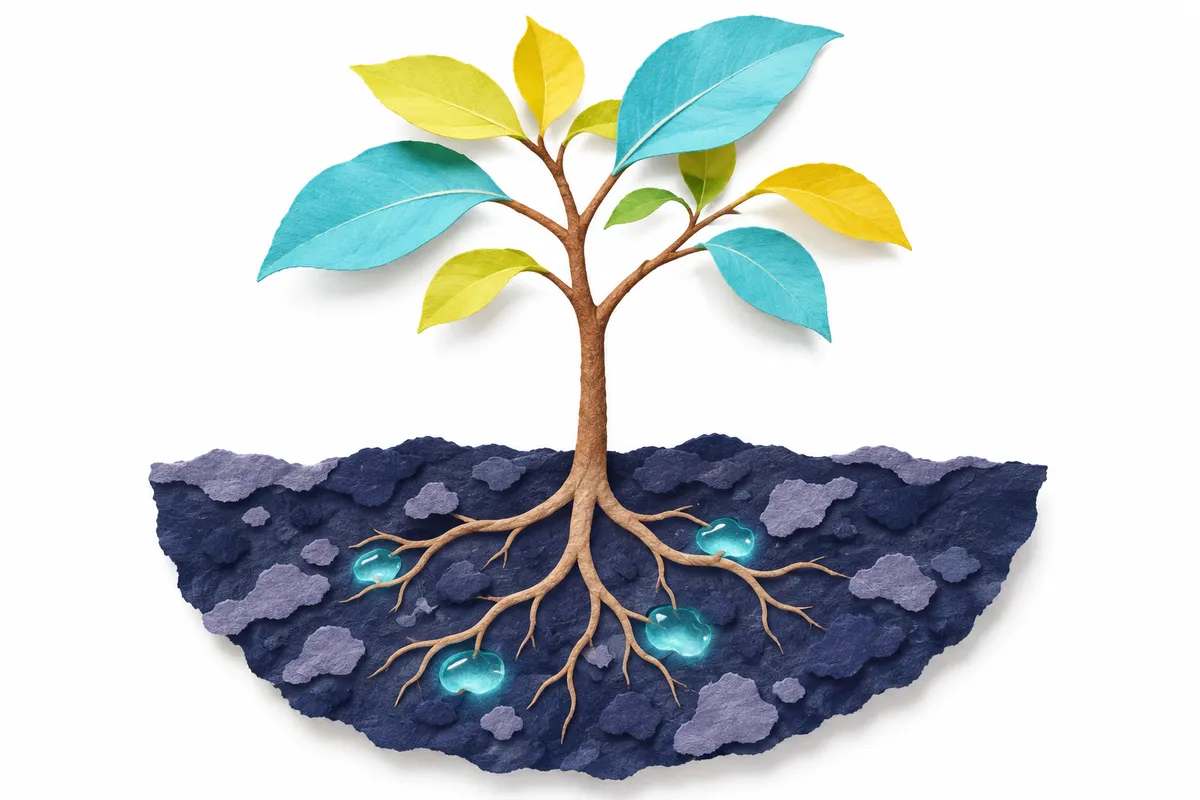
If a tree could choose a superpower
A newly planted tree might choose Elsa’s power from Frozen. The idea wouldn’t be to turn the hillside into a skating rink. It would be to keep water close when the rains take a vacation. Imagine the tree arriving at its new home, putting out its first roots and discovering that nobody here can run out for a bottle of water. It has to live on whatever water it can find.
That’s where hydrogels come in. In reforestation, they can hold water near a tree’s roots and affect how much of it the tree can use. At Global Lemon we use potassium-based formulations. Before we open the bag, it’s worth understanding that choice.
A little water in reserve, without a spell
The granules in some hydrogels look unremarkable until they meet water. Their network of polymers swells and holds the water. As soil conditions change, some of that water may become available to plants. It takes rain or irrigation to recharge the granules. However hopeful we feel, burying dry granules in dry ground won’t summon a raincloud. [1]
Watching the granules swell in a glass won’t tell us what they’ll do on a mountainside. Out there, they encounter salts, roots, soil particles and hot days. What matters is whether the particular species can draw on that water at that site. [1],[2]
Potassium and sodium: two names worth reading on the label
Hydrogels vary in composition. Some contain potassium polyacrylate, others sodium polyacrylate, and still others contain copolymers or blends. Those differences can affect which ions the material exchanges with the soil and how plants respond. Two bags that look alike can have very different effects. [3]
Potassium is a plant nutrient, but a potassium-based hydrogel can’t replace a nutrient management plan. Sodium deserves particular attention where soil or irrigation water already has salinity problems. One comparative trial found that the formulations affected plants differently. Under the study conditions, the sodium formulation inhibited growth more. That finding calls for care in product selection. It cannot tell us how every product will behave at every site. [3]
This is why we prefer potassium-based formulations and review the product’s composition, intended use and application rate. Choosing the material is only the first chapter.
Where does Lluvia Sólida fit in?
Lluvia Sólida is a brand name. Hydrogels are a whole class of materials. The company describes its product as being made from potassium-based polymers. [4] For a specific product, check its current technical data sheet. The ingredients, application instructions and restrictions matter as much as the name on the label.
Using a potassium-based hydrogel does not necessarily mean using this brand. We’re explaining the type of formulation we use. We’re not endorsing a particular product.
The field has the final say
Research offers both promising results and reasons for caution. Agaba and colleagues found that under controlled conditions, more water was available to plants and seedlings survived longer. [2] In another experiment, salinity reduced water absorption by a hydrogel containing potassium acrylate, and applying it reduced maize biomass. The study involved a crop rather than reforestation, but it illustrates how much the chemistry depends on conditions. [1]
To learn what works, compare plants grown under similar conditions with and without the product. Record rainfall and irrigation and track survival and growth. A hydrogel may help, alongside a species suited to the site, good planting and follow-up care.
In the end, our little tree doesn’t need to become a Disney character. It needs someone who understands the ground it’s growing in and knows how to care for it. If a little water in reserve can give it an extra chance, that’s worth investigating. The magic of watching a tree grow starts with some very down-to-earth decisions.
Frequently asked questions
Can a hydrogel replace watering?
It needs a source of water to recharge. How well it works depends on the soil, the species and the formulation. A hydrogel alone cannot replace planning for the project’s water needs.
Are hydrogel and Lluvia Sólida the same thing?
No. Hydrogel is the name for a family of materials. Lluvia Sólida is a brand. The technical data sheet gives the composition of each product.
What kind does Global Lemon use?
We use potassium-based formulations and review their technical specifications. Our choice doesn't imply that one brand or application rate is suitable everywhere, or that it will perform the same way at every site.
About the author
Global Lemon Team. We share knowledge about forest conservation and restoration, drawing on field observations and the sources cited in this article.
Transparency statement
This article was prepared with the help of AI tools and reviewed by Global Lemon’s editorial team. Our account of Global Lemon’s work draws on information provided by Paúl Burgos. The references distinguish our field experience from research findings. This article is for information only. Decisions in the field require a site assessment.
References
- Costa et al. (2022). Hydrogel composed of potassium acrylate, acrylamide, and mineral as soil conditioner under saline conditions. Scientia Agricola.
- Agaba et al. (2010). Effects of Hydrogel Amendment to Different Soils on Plant Available Water and Survival of Trees under Drought Conditions. CLEAN Soil Air Water.
- Situ et al. (2023). Effects of several superabsorbent polymers on soil exchangeable cations and crop growth. Environmental Technology and Innovation 30, 103126.
- Lluvia Sólida. Company profile and product description.