Trees and the Instruments They Become
A guitar’s sound takes shape long before it reaches the stage.
By Global Lemon, Editorial team ·
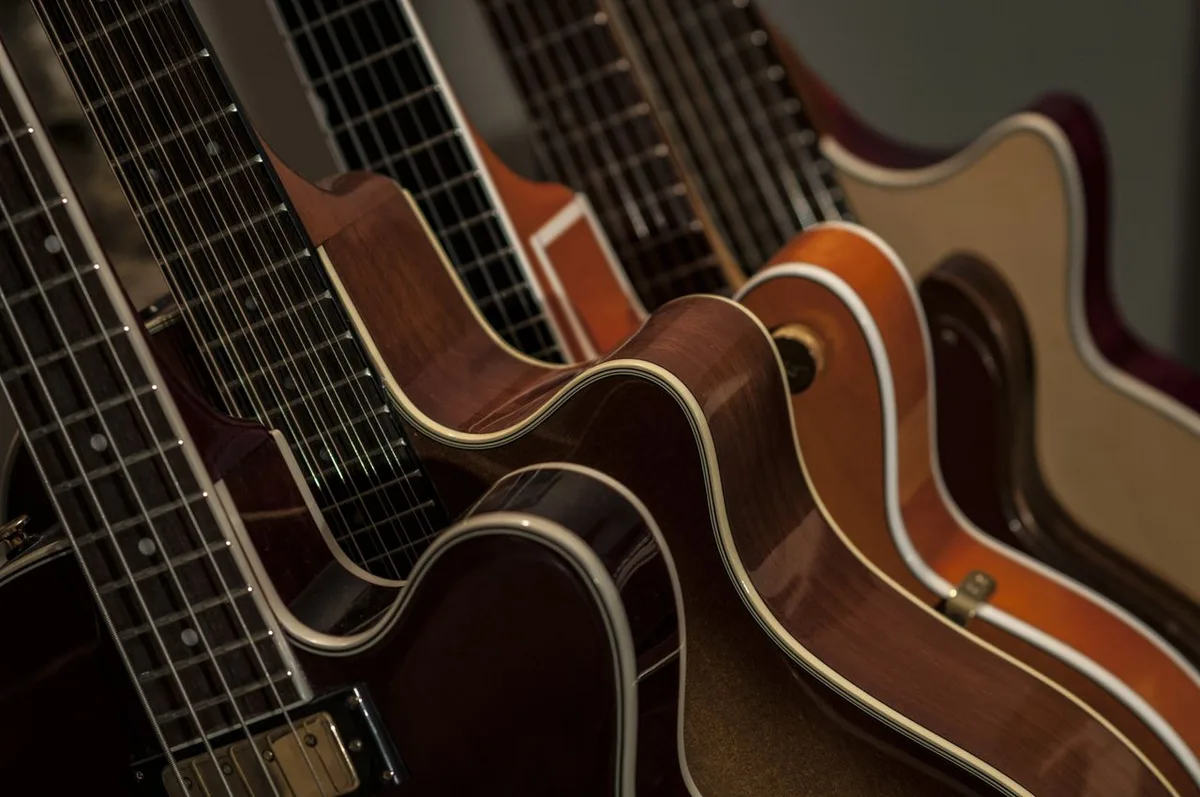
Pluck a string on an acoustic guitar and listen to what happens next. The note swells, takes on body and hangs in the air for a moment. You’re hearing the musician’s touch, the craft of the person who built the instrument and a piece of wood that was once a tree. The guitarist gets the applause. The tree rarely even makes the credits. Let’s give it a little of its due.
A lesson in acoustics, with no exam
Tonewoods are chosen for properties that suit a particular musical purpose. A string alone moves very little air. On an acoustic guitar, the bridge carries the string’s vibration to the soundboard, and the structure helps radiate the sound. The wood’s stiffness, density and ability to damp vibrations all shape that movement. [1]
Think of materials, thicknesses and shapes working together. A soundboard needs to respond readily while bearing a load. A fingerboard has to stand up to wear. How the wood has been cut and dried matters too. Buying a famous species of wood is no more a guarantee of a masterpiece than buying an expensive pen is a guarantee of a good novel.
Each wood has its part to play
Spruce is a familiar choice for soundboards. Maple appears in the backs and sides of stringed instruments, and ebony in parts such as the fingerboard. A violin in the Metropolitan Museum of Art’s collection brings together spruce, maple and ebony in different parts. It would be unfair to ask each wood to do exactly the same thing. Even an orchestra has to divide up the work. [2]
Mahogany and rosewood also have a long history in guitar making. Depending on the design, they can be used for the neck, back or sides. Something quite different happens in a xylophone: the wooden bar itself vibrates when struck. The Grainger Museum holds an example made with Honduran rosewood. That one word, “wood,” covers some very different acoustic jobs. [3],[4]
A fandango has roots too
In Veracruz, that connection sounds like an arpa jarocha, a harp used in the region’s music. A study of instrument maker Andrés Alfonso Vergara documents his use of primavera and nacaste, also known as guanacastle ( Enterolobium cyclocarpum), in the staves of his harp soundboxes. Here, primavera refers to Roseodendron donnell-smithii. The wood varies from part to part and workshop to workshop. Tradition knows how to experiment, too. [5],[6]
And yes, there’s an instrument called a chaquiste, a small jarana from Veracruz. The word can also mean a kind of mosquito. Before opening the windows, you might want to specify which one you’d like to hear. [7]
Keeping the music alive
These crafts can endure only if forests and suitable materials remain available. Some species used in instrument making are threatened, and international trade in certain woods is regulated under CITES. A trade name can cover several different species. Asking where the wood came from and how it was identified will help you make a more informed choice. [8],[9]
Caring for instruments, repairing them and choosing wood whose origin can be traced are also part of the picture. A well-kept guitar can be a companion for years. It deserves a case. The forests that made it possible deserve considerably more care.
Bamboo and a growing partnership
That’s why we’re glad to work with Bamboo, an Argentine company that makes wonderful guitars and ukuleles. Through our partnership, Bamboo has pledged to donate one tree for every instrument it sells.
The donation opens the way to restoration, and that takes work: choosing suitable species, planting when conditions are right and following up afterward. The process deserves as much care in the telling as the music does. While someone learns their first chords, we can help new trees grow. Patience will come in handy on both counts. Neither a forest nor a sure hand on the guitar develops in an afternoon.
Frequently asked questions
What is a tonewood?
A wood chosen for properties that suit a musical purpose. Its suitability depends on which part it is used for and how the instrument is built.
Are all Bamboo instruments made of bamboo?
The brand name doesn’t tell you which wood a particular model uses. Check the specifications for each instrument.
Does donating a tree offset the entire impact of making a guitar?
The donation supports a forest initiative. Claiming a full offset would require assessing and verifying both the impacts and the outcomes using a specific methodology.
About the author
Global Lemon works alongside communities on forest conservation and restoration. This article connects that experience with sources on acoustics, instrument making and conservation.
Disclosure
Global Lemon has a partnership with Bamboo. Global Lemon provided the information about the pledge for each instrument sold. Bamboo México’s public website documents the partnership and its guitar campaign.
References
- Sotomayor Castellanos and Villaseñor Aguilar (2018). Material properties and acoustic performance indices of twenty-two Mexican woods.
- The Metropolitan Museum of Art. Violin and its materials, collection number 504254.
- Taylor Guitars. Guitar Tonewood Types. Guitar materials and components.
- Grainger Museum, University of Melbourne. Xylophone, early 1940s.
- Arboleyda Castro (2016). A new harp for son jarocho: Andrés Alfonso Vergara. La Manta y La Raya.
- Royal Botanic Gardens, Kew. Roseodendron donnell-smithii. Plants of the World Online.
- El Colegio de México. Diccionario del español de México, entry for “chaquiste.”
- Kusnick et al. (2024). Visual analysis of diversity and threat status of natural materials for musical instruments.
- CITES (2023). A guide to CITES-listed tree species.
- Bamboo. About us: the company’s Argentine origins and instrument families.
- Bamboo México. Terms and warranty: the “1 Guitarra 1 Árbol” campaign and partnership with Global Lemon.