Planting and Caring for Cherry Trees in Mexico’s Climates
Find out which conditions cherry trees need in Mexico, how to start them from seed, what they cost and how to care for them as your orchard grows.
By Global Lemon Team ·
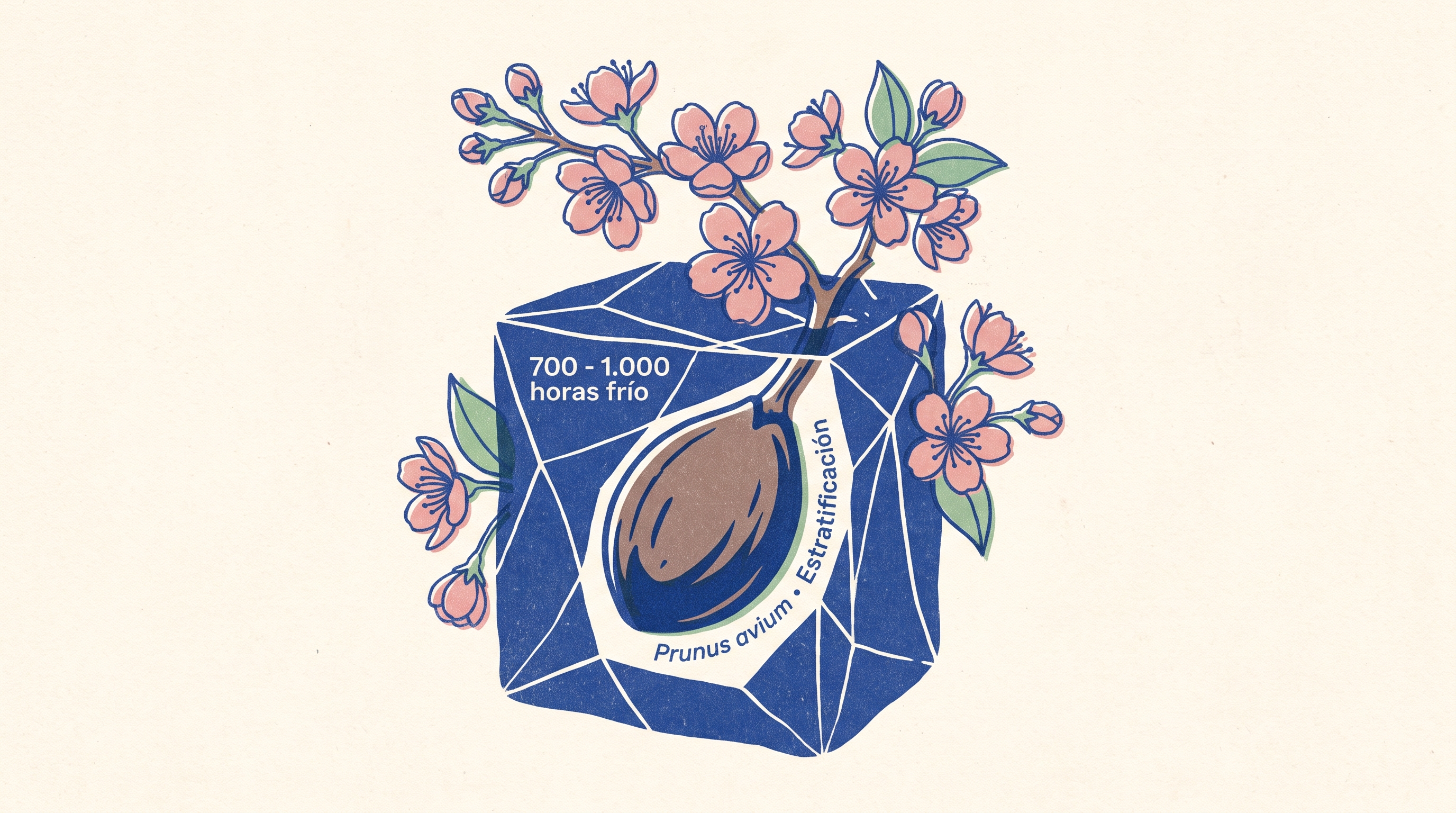
Can cherry trees grow in Mexico? Yes, in regions with the right growing conditions. Sweet cherries need 700 to 1,000 winter chill hours [1], good drainage and specialized care. Chihuahua and Puebla account for most documented commercial production. In warmer areas, consider ornamental cherries, other fruit trees or a trial planting with technical guidance.
Will a cherry tree grow where you live?
You can plant a cherry tree in Mexico if your site accumulates enough winter chill hours. That figure helps determine whether the tree will bear fruit, produce only blossoms or struggle to grow.
Before buying a tree, decide what kind of cherry you want.
- Sweet cherry (Prunus avium): the usual choice for fresh fruit, with the highest chilling requirement of the types listed here.
- Sour cherry (Prunus cerasus): used for preserves and baking.
- Ornamental cherry. Grown for its blossoms.
These trees have different growing requirements and yields. At Global Lemon, we want people to understand why a tree is chosen and how its environmental and community benefits can be verified. This guide distinguishes documented results from outcomes that depend on your site.
What growers keep coming back to: winter chill, patience and good seed
Without enough winter chill, there is no fruit. Growing a cherry from a pit also means waiting several years. The requirement of 700 to 1,000 chill hours [1] cannot be met in a warm climate or a heated greenhouse.
Growers report success with the following practices.
- Choose pits from fresh cherries, preferably local or organic, that have not been treated or frozen.
- Cold-stratify the pits for 10 to 12 weeks in the refrigerator, using damp moss or paper.
- Work out a budget before expanding from a single tree to a commercial orchard.
Choosing a site by its chill hours and regional growing conditions
Start with the chill hours recorded in your municipality. A description such as “temperate” tells you little on its own. Ask for actual figures. Local weather stations, an agronomist in your area or your state agricultural office can help.
| Region or example | Figure or observation | What it means |
|---|---|---|
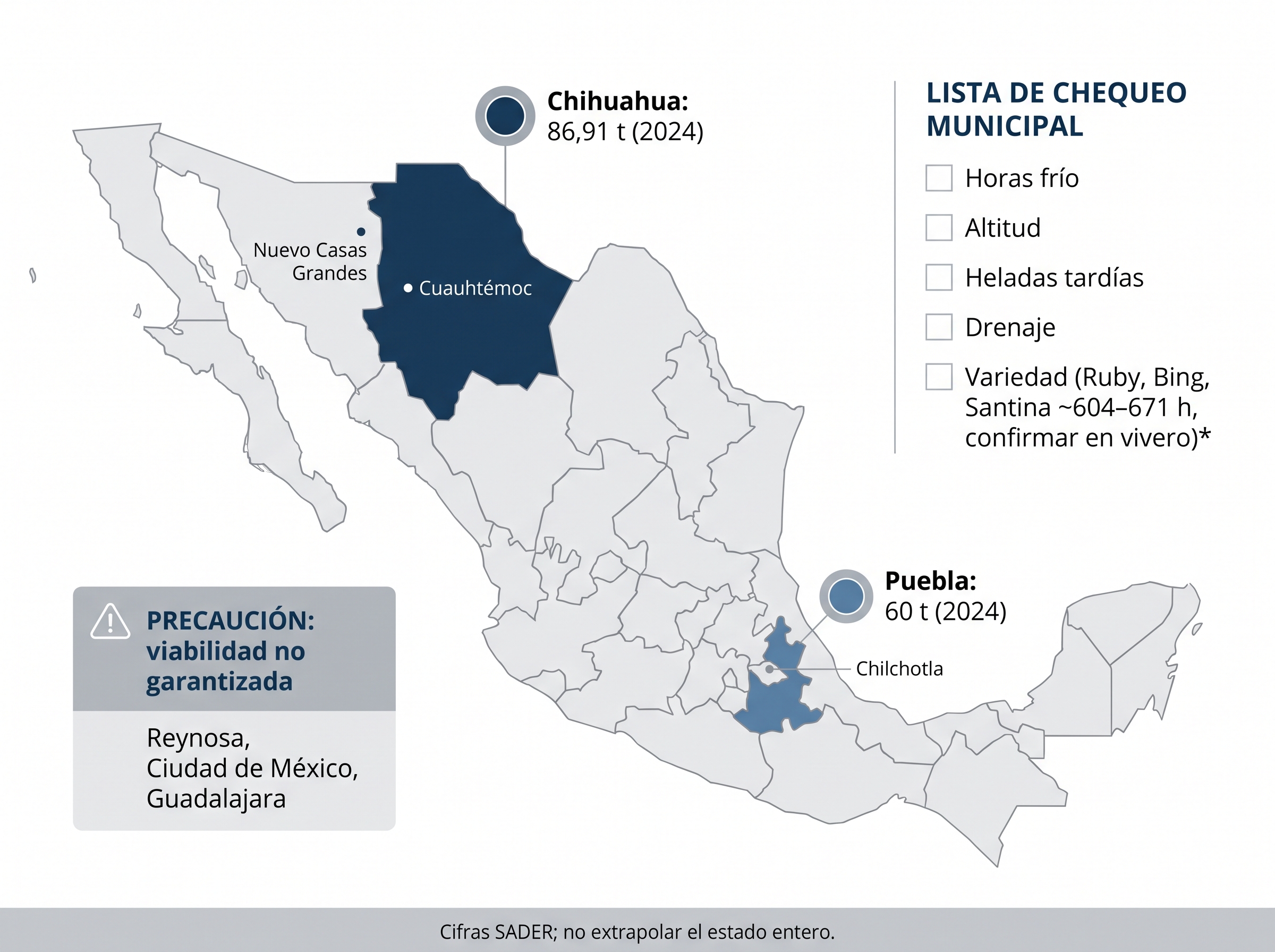
| Chihuahua | 86.91 metric tons in 2024 | Leading recent example of commercial production |
| Puebla | 60 metric tons in 2024 | Production is concentrated in specific areas |
| Nuevo Casas Grandes and Cuauhtémoc | Municipalities cited as examples | Winter chill and soil conditions need to be assessed locally |
| Chilchotla, Puebla | A municipality reported to produce cherries | Conditions there do not represent the entire state |
| Ruby, Bing and Santina | Approximately 604–671 chill hours, as reported | Requirements may differ from the usual range for sweet cherries. Confirm with the nursery. |
Chihuahua and Puebla figures are from SADER, as reported by regional media.
Considering Reynosa, Mexico City or Guadalajara? Success is uncertain. Before buying, check local chill hours, elevation, late frosts, drainage and cultivar suitability with a qualified adviser.
Establishment costs for a single tree, a home orchard or a hectare
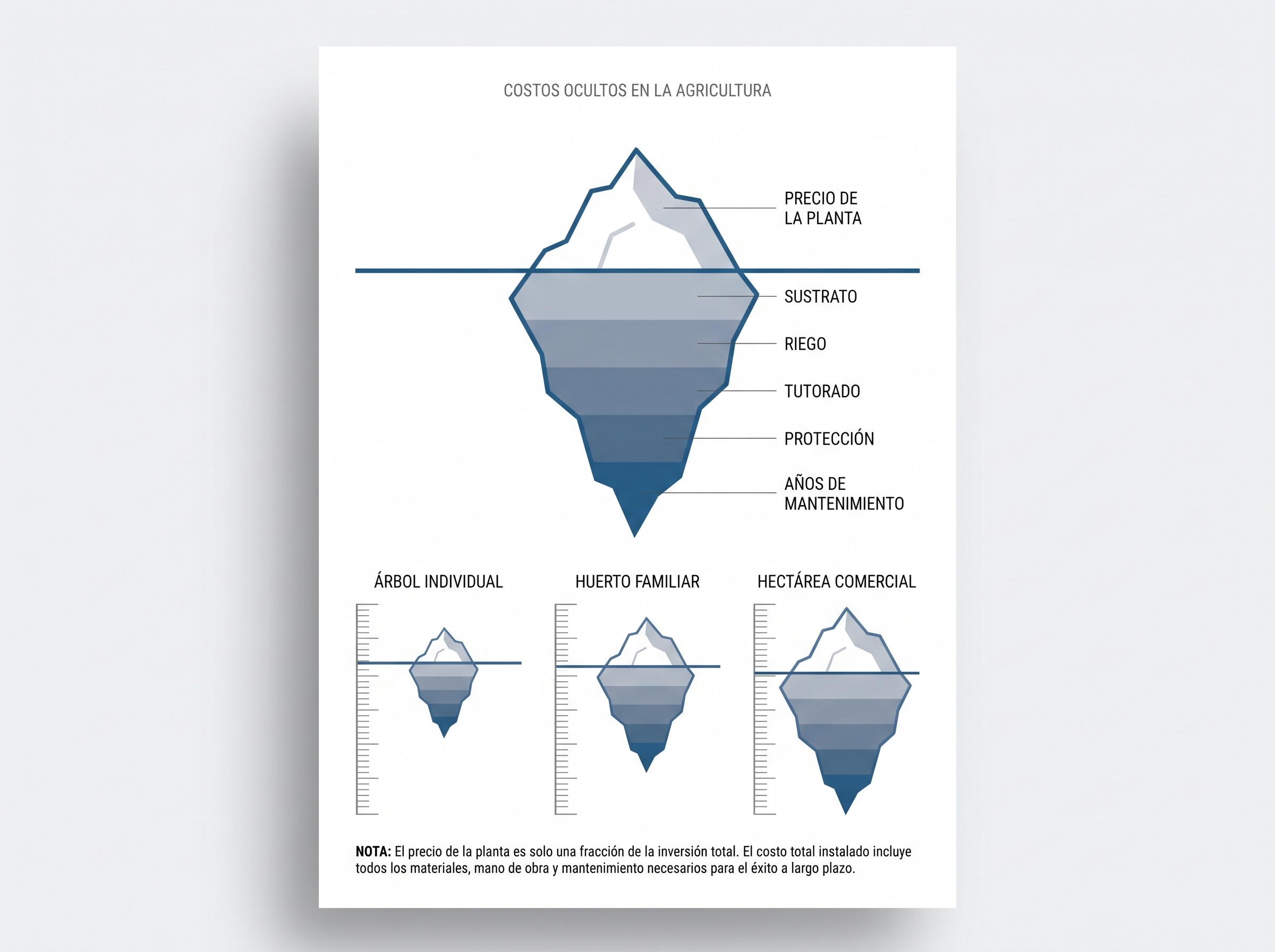
The purchase price is only the start. Include growing medium, irrigation, staking, protection and years of maintenance.
| Scale | Benchmark | How to use it |
|---|---|---|
| Semi-dwarf tree on Gisela 5 rootstock | €25–60 for a bare-root tree in Europe [9] | An international benchmark. Ask a nursery in Mexico for a local price. |
| Home orchard | Tree, planting hole, stake, watering and protection | Budget per tree planted |
| One hectare of commercial orchard | More than 1,000 trees [10] | Requires infrastructure and substantial investment |
| Orchard removal | 4–5 million Chilean pesos (CLP) per hectare [10] | A removal cost in Chile, distinct from the cost of establishing an orchard in Mexico |
At the height of the season, fresh cherries are quoted at €8–15 per kilogram in Spain and elsewhere in Europe [9]. That helps explain the investment in technology at those orchards. It does not establish what a Mexican orchard will earn. When requesting a quote, ask about tree size, rootstock and shipping, and distinguish the purchase price from the total cost of getting a tree into the ground.
Growing cherries from seed, from cold treatment to the first harvest
A cherry pit can germinate with cold stratification and controlled moisture. Expect to wait years for fruit.
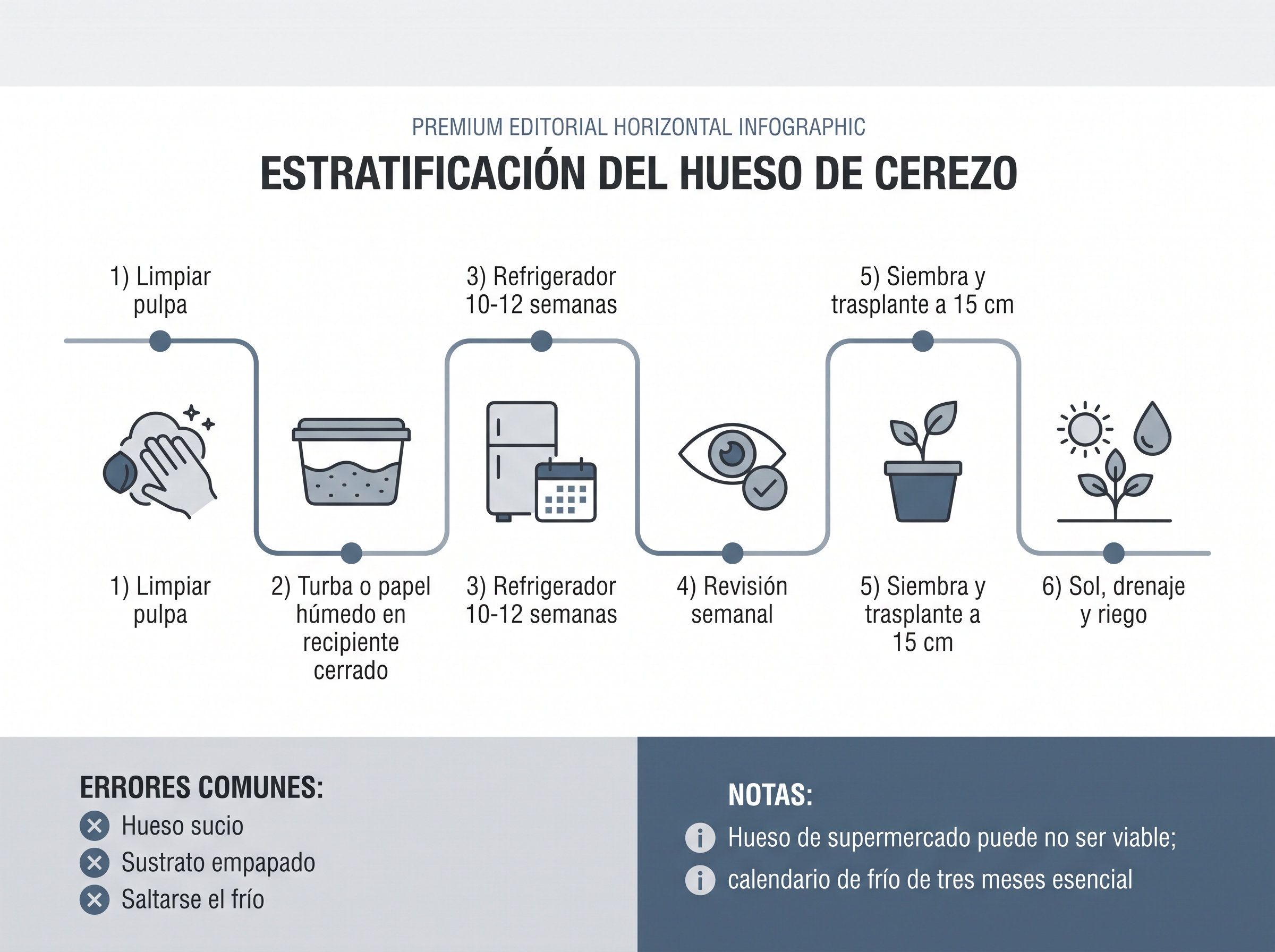
- Clean the pit, removing all traces of flesh.
- Put it in a closed container with slightly damp peat, moss or paper.
- Refrigerate it for 10 to 12 weeks. Keep the material from becoming waterlogged.
- Check weekly for moisture, mold and signs of germination.
- Sow in a pot, then transplant when the seedling reaches about 15 cm in height.
- Provide sun, good drainage, moderate watering and protection until the tree is established [5].
Common mistakes include leaving flesh on the pit, soaking the growing medium, skipping cold stratification or planting in waterlogged ground.
A realistic timeline includes three months of stratification, germination in spring if the seed is viable, and root development in the first year. A grafted tree can produce fruit reliably after four or five years [9]. A tree grown from seed takes longer.
Transplant on a cool, still day [3]. A supermarket cherry may come from a cultivar poorly suited to your climate, and the tree that grows from its pit may differ from the parent. If your goal is a harvest, a grafted tree is the more reliable option.
Grafted tree or seedling for a fruit harvest?
| Option | Advantages | Drawbacks |
|---|---|---|
| Grafted tree | More predictable fruiting after about four or five years. The cultivar is known, and the rootstock can be selected for vigor and soil conditions. | Higher upfront cost. Supply depends on the certified nursery, shipping and availability of the rootstock. |
| Tree grown from a pit | Inexpensive and useful for learning. Allow 10–12 weeks for stratification and a first year of root development. | It takes longer to fruit. A supermarket cherry pit may produce a tree unlike its parent and poorly adapted to your climate. |
Yields per hectare and what comparisons can tell you
International reports put the yield of a mature orchard at around 8 to 12 metric tons per hectare [7][8]. Local data are needed before assuming a similar yield in Mexico.
| System or example | Figure or observation | Context |
|---|---|---|
| Chilean orchards in full production | About 12 t/ha [7] | Yield per hectare |
| Early Burlat/Carly cherries | Around 8,000 kg/ha [8] | Caspe, Aragón, Spain |
| Türkiye | 726,500 metric tons in 2024 (23.39% of world output) [6] | National production volume rather than yield per hectare |
| Chile | 596,967.55 metric tons in 2024 (19.22% of world output) [6] | National production volume |
National production, yield per hectare and the amount of marketable fruit measure different things. Cultivar, orchard age, pollination, pruning, frost and tree health all affect the harvest. Use the figures as planning ranges. They do not guarantee a financial return.
Cherry trees in reforestation and community agroforestry
Cherry trees provide blossoms, food for pollinators and structure, but their suitability for reforestation depends on the site.
Prunus avium can reach about 30 meters under favorable conditions. Distinguish four uses: a fruit orchard, an ornamental planting, an agroforestry system and ecological restoration. For restoration, give priority to species native to the region.
To get involved with Global Lemon, explore our projects, make a donation, volunteer or take part in a corporate social responsibility program. Always ask for figures on tree survival.
Limits, alternatives and professional advice
The chill hours, costs and yields in this guide are benchmarks. Actual results vary. Sweet cherries need 700–1,000 chill hours [1]. If your area falls short, consider better-adapted fruit trees or ornamental cherries [4].
Before planting a hectare, have the soil and water tested, review frost records, plan for pollination, select a rootstock and study the market. Consult a certified nursery or a local agronomist. Watch for gummosis, pests, overwatering and improper pruning [1].
Frequently asked questions about cherry trees
Where in Mexico can I plant a cherry tree?
Look for a site with enough winter chill, good drainage and direct sunlight. Chihuahua and Puebla offer commercial examples. Verify conditions at the municipal level.
When should I plant a cherry tree?
Plant while the tree is dormant, in fall or winter, avoiding frozen, waterlogged or very dry soil [2][5]. The exact date depends on elevation and frost risk. There is more flexibility with a potted tree, provided it is watered during establishment.
How long does a cherry tree take to bear fruit, and how much does it produce?
A grafted tree can bear fruit reliably after four or five years [9]. A seedling takes longer. International reports put some mature orchards at about 8–12 t/ha [7][8]. In Mexico, the outcome depends on the site and how the orchard is managed.
Can I grow a cherry tree in a warm area?
A fruit harvest is unlikely. Without enough winter chill, the tree may grow but flower and fruit poorly. An ornamental cherry or another locally adapted fruit tree is often a better choice.
Making an informed decision about planting
Three decisions shape the prospects for a cherry planting in Mexico.
- Confirm the chill hours in your municipality before buying.
- Calculate the full cost, including the expense of establishing and maintaining the tree.
- Plan for the wait. Allow years for the first harvest.
Chihuahua and Puebla offer examples of commercial production. Yields in Chile or Europe do not predict the yield at your site. Explore our projects, Planting and My Trees pages. If you manage a corporate social responsibility program, ask for tree survival data and verifiable environmental results.
About the author
Global Lemon team
We write to explain these topics clearly and help you make decisions with reliable information.
Transparency statement
Sources include SADER, Mexican regional media, Portalfrutícola, Redagrícola, Valencia Fruits, AtlasBig, Sembrar100 and the gardening community. Costs and yields vary. Seek professional agronomic advice for your site.
References
[2] Cómo y cuándo plantar un cerezo: la guía completa [How and when to plant a cherry tree]
[6] Producción de Cereza por País 2024 [Cherry production by country in 2024]
[9] ¿Puedes cultivar Cerezo? Zonas 4-8 y cuidados [Growing cherry trees in zones 4–8]