The Understory: Life Among the Trees
With care suited to each site, shrubs, herbs and young plants help rebuild the relationships that make a forest.
By Global Lemon, Editorial team ·
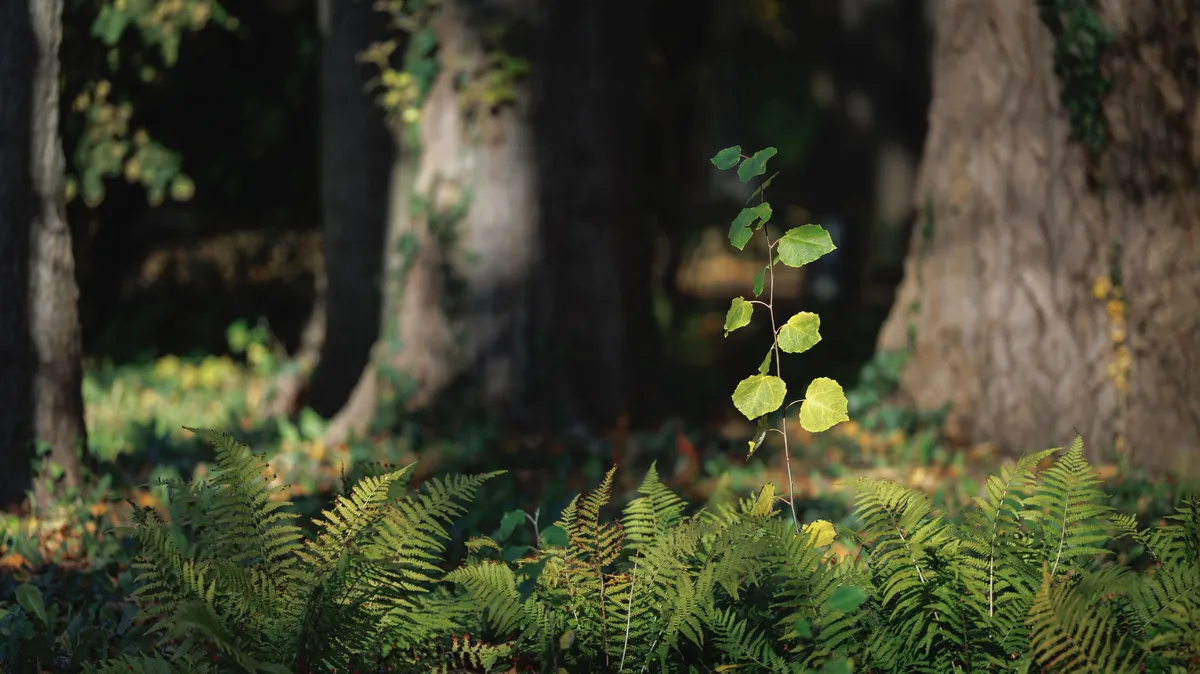
A forest has more than one story
When we picture a forest, we usually look up at tall trunks, branches and crowns. Look down and another part of the story comes into view. Shrubs, herbs, ferns and young plants grow in the spaces beneath the canopy. Together, this living vegetation makes up the understory. What grows there changes with the ecosystem and its stage of recovery.
Leaf litter matters too, but it belongs to the forest floor. It isn’t living understory in its own right. The distinction helps explain what each does. Think of a forest as a building full of life: the lower stories have inhabitants of their own. Restoring a forest means looking after them as well as admiring the roof.
What happens close to the ground
Low-growing vegetation helps shield the soil from the impact of raindrops and can slow water flowing over the surface. Its roots work with other parts of the forest to hold soil in place. The FAO identifies both understory vegetation and leaf litter as contributors to this protection. [1]
The understory also provides animals with food, shelter and routes through the forest. These relationships reach up into the canopy. In an experiment in Swedish woodlands, removing the understory changed how birds preyed on arthropods. [2] We can’t assume the same result in every Mexican forest, but the finding shows how changing one layer can alter what happens in another.
Neighbors can shelter one another or compete
Nearby vegetation changes the conditions a young plant experiences. It can provide shelter and moderate exposure, but it also uses water, nutrients and light. The balance depends on the species, their density, the soil and the season. A plant that makes an excellent neighbor under one set of conditions may take up too much space under another.
In a dryland restoration experiment, researchers sowed grasses alongside shrubs at sites with different levels of soil fertility. At some sites, the plants helped one another. At others, they competed. [3] That’s a reason to set blanket rules aside. Keeping every plant without assessing the site can harm a tree. Clearing everything around it can remove vegetation that was helping.
Choosing what to clear and what to keep
Management starts with identifying what is growing and what the plant we hope to establish needs. We may need to clear competing vegetation from the area immediately around it, control invasive species or intervene where vegetation stands in the way of the restoration goal. That work calls for selective action, with attention to fire risk and the material that could fuel a fire.
Tidiness alone tells us little about ecological condition. A site swept clean can lose valuable cover. A site completely covered in vegetation can conceal an invasion. It helps to be explicit about which species and vegetation structures we want to encourage, what we plan to remove and why. We should be able to explain those choices even when the result hardly looks like a freshly groomed garden.
Each layer has its own timing
Restoring the understory doesn’t mean introducing every species on planting day. Some tolerate open ground. Others need conditions that emerge as the canopy develops. In an experiment in riparian forests along the Sacramento River, researchers studied how shade, competition from grasses and different ways of introducing plants affected native understory species. [4]
The practical lesson is to plan in stages around each species’ needs. Protecting natural regeneration may be part of the job. Where seed sources are missing or other barriers persist, additional planting may be necessary, using species suited to the ecosystem. Diversity needs a chance to arrive.
What research in Mexico can tell us
A study by researchers at the Colegio de Postgraduados and the Universidad Autónoma del Estado de México, published in Polibotánica, proposes including understory diversity in assessments of forest restoration. [6] It’s a valuable invitation. Counting trees helps, but looking at the plants that grow alongside them lets us ask other questions about how the forest is recovering.
Start by identifying the ecosystem
This discussion applies where forest or woodland is the appropriate reference ecosystem. Naturally open grasslands and shrublands have a structure and biodiversity of their own. Ecological restoration seeks to recover the native ecosystem that belongs at the site. That reference guides decisions about which vegetation to encourage and which changes to avoid. [5]
At Global Lemon, understanding the understory broadens how we look at the trees we care for. Each project needs to consider which plants belong alongside those trees and how to help them grow. As recovery progresses, our attention shifts from individual trees to the relationships that sustain a living community.
Frequently asked questions
Is leaf litter part of the understory?
Leaf litter is part of the forest floor. The understory is the living vegetation beneath the canopy, including shrubs, herbs and young plants.
Should all vegetation around trees be removed?
There’s no universal rule. Selective management takes account of competition, native vegetation, invasive species, site conditions and fire risk.
About the author
Global Lemon Team. We share knowledge about forest conservation and restoration, drawing on field observations and the sources cited in this article.
Transparency statement
This article was prepared with the help of AI tools and reviewed by Global Lemon’s editorial team. Our account of Global Lemon’s work draws on information provided by Paúl Burgos. The references distinguish our field experience from research findings. This article is for information only. Decisions in the field require a site assessment.
References
- FAO. Sustainable Forest Management Toolbox: Forest and Water, In more depth.
- Heyman, E. and Gunnarsson, B. (2011). Management effect on bird and arthropod interaction in suburban woodlands. BMC Ecology 11:8.
- Uselman, S. M. et al. (2018). Restoring dryland old fields with native shrubs and grasses: Does facilitation and seed source matter? PLOS ONE 13(10):e0205760.
- Moore, P. L., Holl, K. D. and Wood, D. M. (2011). Strategies for Restoring Native Riparian Understory Plants Along the Sacramento River: Timing, Shade, Non-Native Control, and Planting Method.
- Society for Ecological Restoration. What is Ecological Restoration?
- Herrera-Ávila, I., Plascencia-Escalante, F. O., Pérez-Suárez, M., Hernández-de la Rosa, P. and Ángeles Pérez, G. (2025). Diversidad del sotobosque: un atributo de evaluación en las estrategias de restauración forestal [Understory diversity as a measure for evaluating forest restoration strategies]. Polibotánica 60:123–139. DOI 10.18387/polibotanica.60.8.