Environmental Team Building: Planting Trees Together at Work
Explore how a tree-planting day can bring colleagues together, support ecosystem restoration in Mexico and strengthen your corporate social responsibility program.
By Global Lemon Team ·
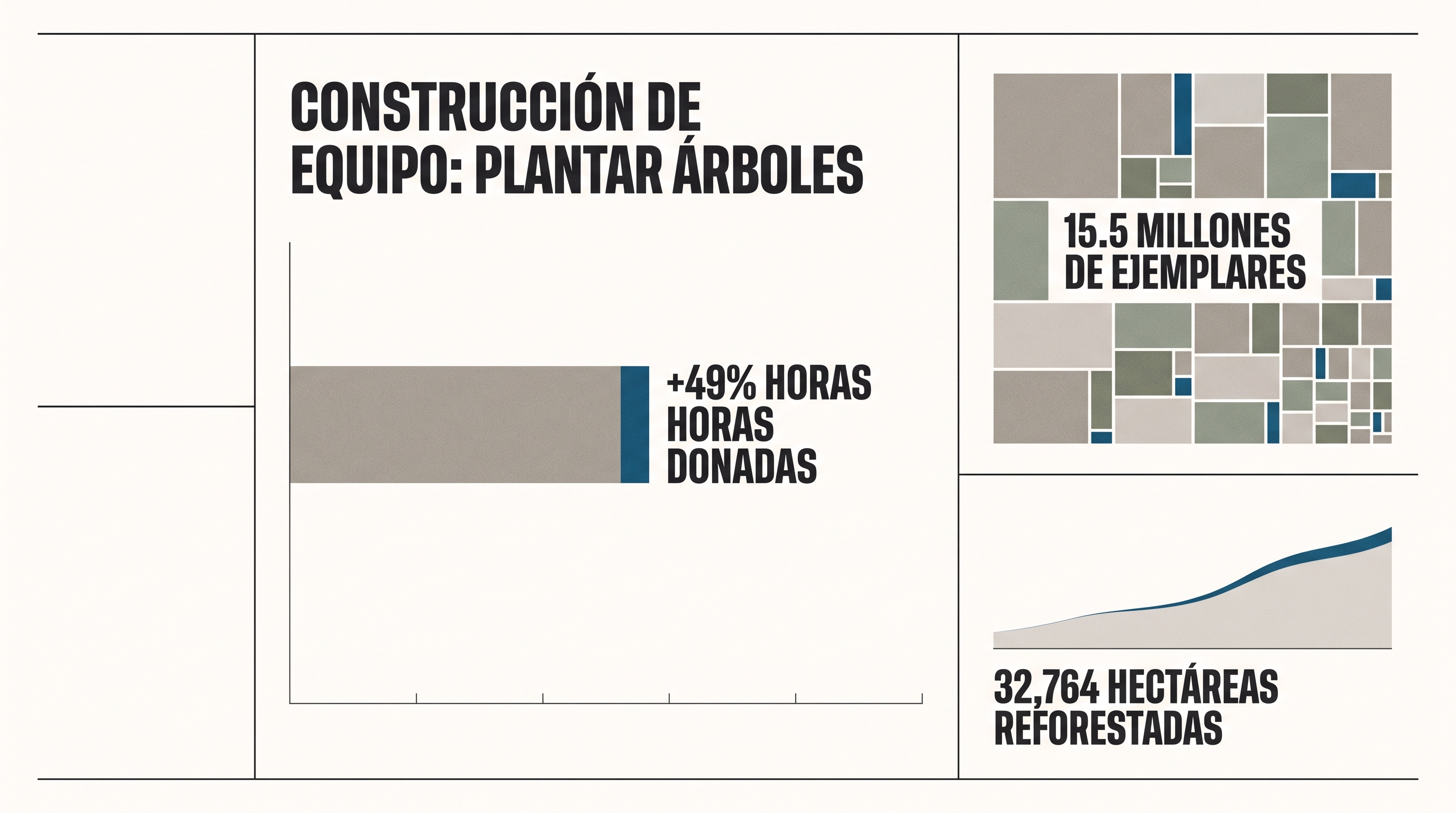
Key takeaway: Tree planting works as a team-building activity when it involves native species, local communities and a plan to track survival. To assess a planting day, look at how many trees are still alive years later. Document volunteer hours, the site, the species, local partners and the maintenance plan for your corporate social responsibility (CSR) program.
Why planting trees works as a team-building activity
Picture your team with tools in hand, boots on the ground and a shared goal they can see at the end of the day. You might call it a reforestation day, corporate environmental volunteering or sustainable team building: a way for a team to work together for a tangible environmental benefit [9].
Interest is growing. According to Giving in Numbers 2025 from CECP, around a quarter of employees take part in corporate volunteering, and the hours they contributed increased by 49% from 2022.
People respond differently to team activities. On Reddit, one user put it bluntly: “That kind of stuff makes me cringe, BUT I know it works and people like it.” The practical lesson is that an experience feels less like a compulsory exercise when the team can see a real goal.
Mexico offers one example of the scale of the work. With Semarnat and Conafor coordinating, the Mexican government plans to reforest 32,764 hectares with 15.5 million trees in 2025–2026 to restore forests, conserve soil and improve water capture [1]. Your company can be part of that effort if its involvement extends beyond the group photo.
How much does a reforestation team-building day cost in Mexico?
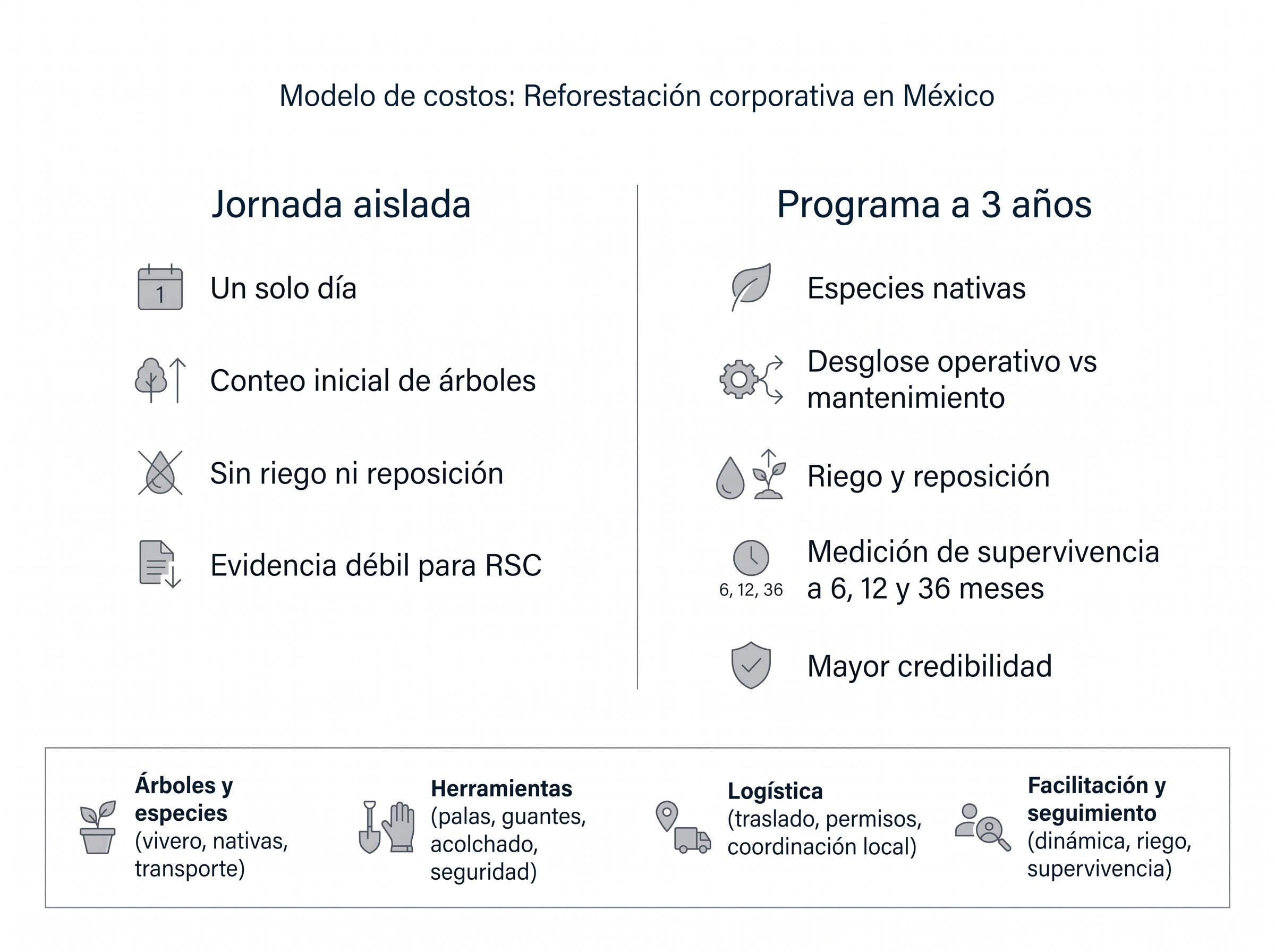
Estimate the cost of the entire event. Account for group size, transportation, species selection, permits, tools, facilitation and monitoring. A price per tree alone cannot tell you what the day will cost.
| Cost item | What it covers |
|---|---|
| Trees and species selection | Nursery stock, selection of native species, transport |
| Tools | Shovels, gloves, mulch, safety equipment |
| Logistics | Transportation, permits, local coordination |
| Facilitation and follow-up | Team activities, watering, survival monitoring |
Published planting prices can serve as a starting point, but an event for employees involves much more. A transparent quote separates operating expenses from maintenance. That distinction helps you judge both the cost and the credibility of a one-day event or a three-year program. Always ask for an itemized quote in writing.
How to document reforestation for CSR, the Distintivo ESR, ISO 26000 and GRI
Along with the initial tree count, keep a record of the goals, participants, hours, location, species, local partners and follow-up work.
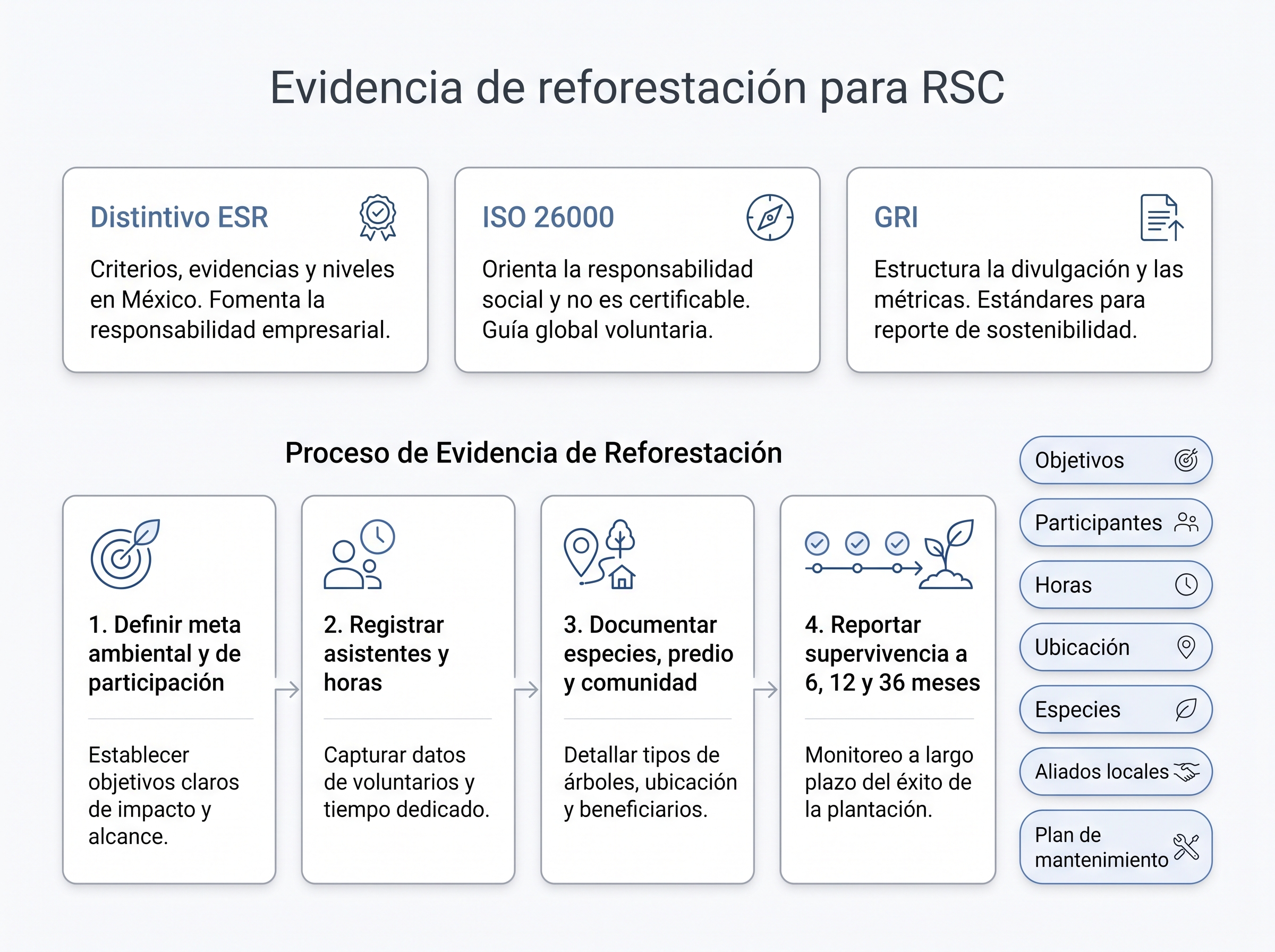
Each framework serves a different purpose, as Crowe México explains [5]:
- Distintivo ESR: sets criteria, evidence requirements and levels of recognition in Mexico.
- ISO 26000: offers guidance on social responsibility. It is not a certification standard.
- GRI: provides a framework for disclosures and metrics.
At a minimum, set environmental and participation goals, record attendance and hours, document the species, site and community, and report survival at 6, 12 and 36 months. My Trees lets you follow the trees associated with your contribution.
What makes tree planting ecosystem restoration?
Restoration requires assessing the site, choosing species, caring for the soil, involving the people who manage the land and checking that trees survive. Consider three approaches: symbolic planting (no maintenance), planned reforestation (defined site and species) and ecological restoration (recovery of soil, water, biodiversity and community ties).
From the group photo to ecosystem restoration
| Approach | Advantages | Limitations |
|---|---|---|
| Symbolic planting | Can be organized in a day and gives the team immediate visibility. | No upkeep or monitoring. It does not restore soil, water or biodiversity. |
| Planned reforestation | The team identifies the site and native species and has technical guidance on planting. | The work can stop at the initial count if there is no watering, replacement planting or local partner. |
| Ecological restoration | Restores soil, water, biodiversity and relationships with the people who manage the land. | Takes more time, ongoing maintenance and checks on survival after five or ten years. |
Frietsch and colleagues (2025) propose moving from planting trees to regenerating the relationships between people and nature [4]. This is central to the UN Decade on Ecosystem Restoration (2021–2030), which aims to prevent, halt and reverse ecosystem degradation on every continent [2]. FAO documents the same shift in Africa’s Great Green Wall, from a campaign to plant a continuous belt of trees to a patchwork of rural development projects [3].
The question worth asking is how many of the trees are still alive five or ten years after planting. On our sites, we can see the difference between plots watered in the first year and those left unwatered as early as the first dry season.
Checklist for spotting greenwashing, inspired by University of Maryland Extension [8]:
- Which species will be planted, and are they native to the site?
- Who manages the land over the long term?
- What is the plan for watering and replacing lost trees?
- How and when will survival be measured?
- Is the company also reducing its emissions?
Planting alone cannot offset a carbon footprint. It is one part of a wider effort.
Which native species should you consider in different parts of Mexico?
No single tree suits the entire country. The right choice depends on the region, elevation, soil, rainfall and ecological goals for the site.
| Criterion | What to check | Why it matters |
|---|---|---|
| Region and elevation | Climate at the site | Determines which species can survive |
| Soil and water | Site preparation and irrigation | Affects survival in the first year |
| Ecological plan | The site’s intended use | Aligns planting with restoration goals |
PROFEPA has documented native species such as Pinus pseudostrobus, Pinus patula, Pinus rudis, Juniperus deppeana and Pinus cembroides [6]. These are examples from a temperate high-elevation environment. Other sites need their own assessment. For a look at our approach, explore our projects and La Primavera Forest.
Global Lemon’s Planting program: 10 tree-based team activities
Planting combines an orientation, assigned roles, quality standards and follow-up. The day can include:
- An introduction to the local ecosystem.
- Teams that rotate roles.
- A timed exercise setting up workstations.
- A native species identification challenge.
- A planting activity scored on quality rather than speed.
- A crew that applies mulch and protects the soil.
- A map the team makes together of the area where it worked.
- A quiz on biodiversity and corporate social responsibility.
- A closing circle where team members share their commitments.
- Recognition for collaboration, safety and planting technique.
Competition should never encourage careless or rushed planting. One example of large-scale participation was the 2026 Cox Race, which brought 500 participants to Chapultepec and tied each kilometer to a pledge to plant a tree [10]. See how Planting works.
Frequently asked questions
Can I volunteer to plant trees in Mexico, and what is this activity called?
Yes. Associations, communities, public agencies and businesses organize reforestation days and environmental volunteering. In a workplace setting, it is often called sustainable team building. Confirm the location, species, land manager and maintenance plan.
How much are people paid to plant trees?
Volunteering is unpaid. Forestry crews and nurseries do charge for planting and maintenance. If you are booking a planting day, ask for an itemized estimate, clear responsibilities and documented follow-up.
Which activities encourage teamwork?
Look for activities with a shared goal, clearly assigned roles and time to reflect together afterward. Species identification, workstations, mapping and team planting are examples. Make them safe, inclusive and accessible to people with different physical abilities.
Before booking a corporate planting day
Consult forestry specialists, environmental authorities and local communities before making public commitments. Results depend on the climate, species, soil, maintenance and social conditions. Planting trees cannot replace emissions cuts in your operations [8].
A team activity that can take root
A worthwhile reforestation day combines cooperation with restoration you can verify. Before signing an agreement, review five things: a transparent budget, metrics tied to your CSR goals, safeguards against greenwashing, suitable species and land, and a three-year follow-up plan.
The team comes home with dirt on its shoes and a story that no indoor activity can match. If you are ready to take that step, organize your planting day with Global Lemon.
About the author
Global Lemon Environmental Content Team. We design and run reforestation programs, community agroforestry projects and corporate environmental activities in Mexico, Colombia and the United States. We work with nurseries, ejidos (communally held land in Mexico) and local forestry specialists.
Disclosure
Global Lemon offers planting and restoration experiences, including its own Planting program. The sources below support the discussion of reporting frameworks, environmental risks and species selection.
References
[1] Mexico to plant 15.5 million trees: the reforestation strategy explained — Emprendedor
[2] International principles and standards for the practice of …
[3] The State of the World’s Forests (SOFO) 2026 | FAO
[4] From planting trees to regenerating people–nature systems
[5] Integrating social responsibility into strategic planning
[6] PROFEPA takes part in a reforestation campaign
[7] Reforestation: Methods and Benefits
[9] Sustainable team building for businesses
[10] Volunteers join a reforestation program to plant 12,000 trees in Mexico — Yahoo Noticias