What Is a CLUNI and Why Check It Before Giving to a Nonprofit in Mexico?
Find out what a CLUNI is, how to look up a civil society organization in Mexico and how to make an informed donation while avoiding fraud.
By Global Lemon Team ·
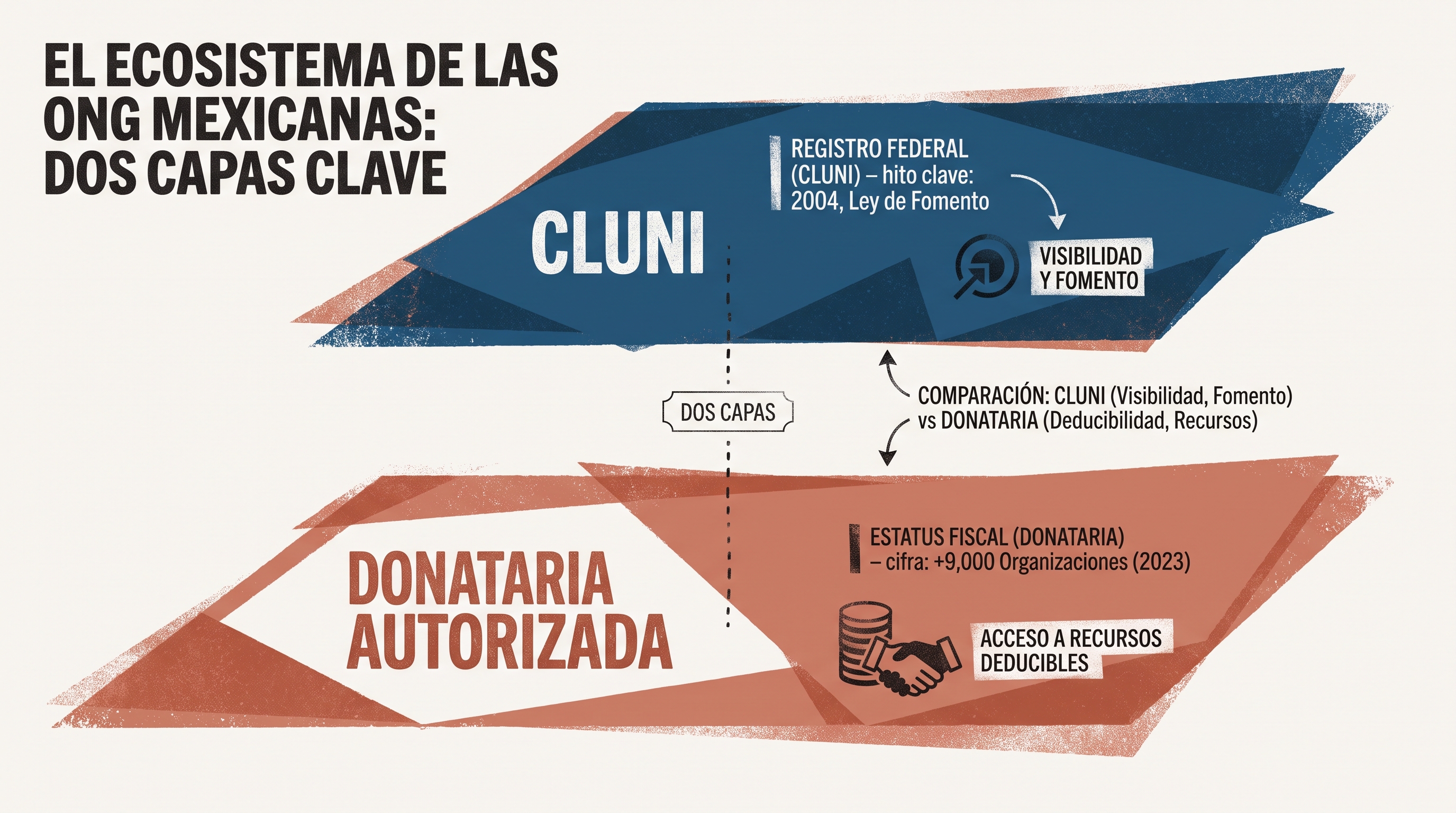
At a glance A CLUNI is a unique registration number in Mexico’s Federal Registry of Civil Society Organizations [4]. It officially identifies a civil society organization (CSO) to the federal government and helps it apply for public funding, calls for proposals, and agreements. No tax authorization comes with a CLUNI. It does not allow an organization to issue receipts for tax-deductible donations [9]. Registration is free and takes place online.
The CLUNI is how the Mexican government officially identifies a registered civil society organization. The number comes from the Federal Registry of CSOs, established under the Federal Law to Promote Activities Undertaken by Civil Society Organizations (LFFAROSC, by its Spanish initials) [6].
Many organizations and donors confuse this registration with authorization to receive tax-deductible donations. The distinction matters, and overlooking it can be costly. This guide explains the difference, a change in Mexico’s 2025 tax rules, the application process, annual reporting, and how to check a CSO before donating or entering into a corporate social responsibility (CSR) partnership.
How the CLUNI identifies civil society organizations within Mexico’s federal system
The Federal Registry assigns a CLUNI to each organization it registers. The number confirms that the CSO meets the requirements of the federal law promoting its activities. The registration neither incorporates the association nor grants it tax authorization.
There are two stages. First, the civil association is incorporated as a legal entity before a notary public. It can then enroll in the Federal Registry, which is linked to the Comisión de Fomento, the interagency commission established under Article 10 of the LFFAROSC [5].
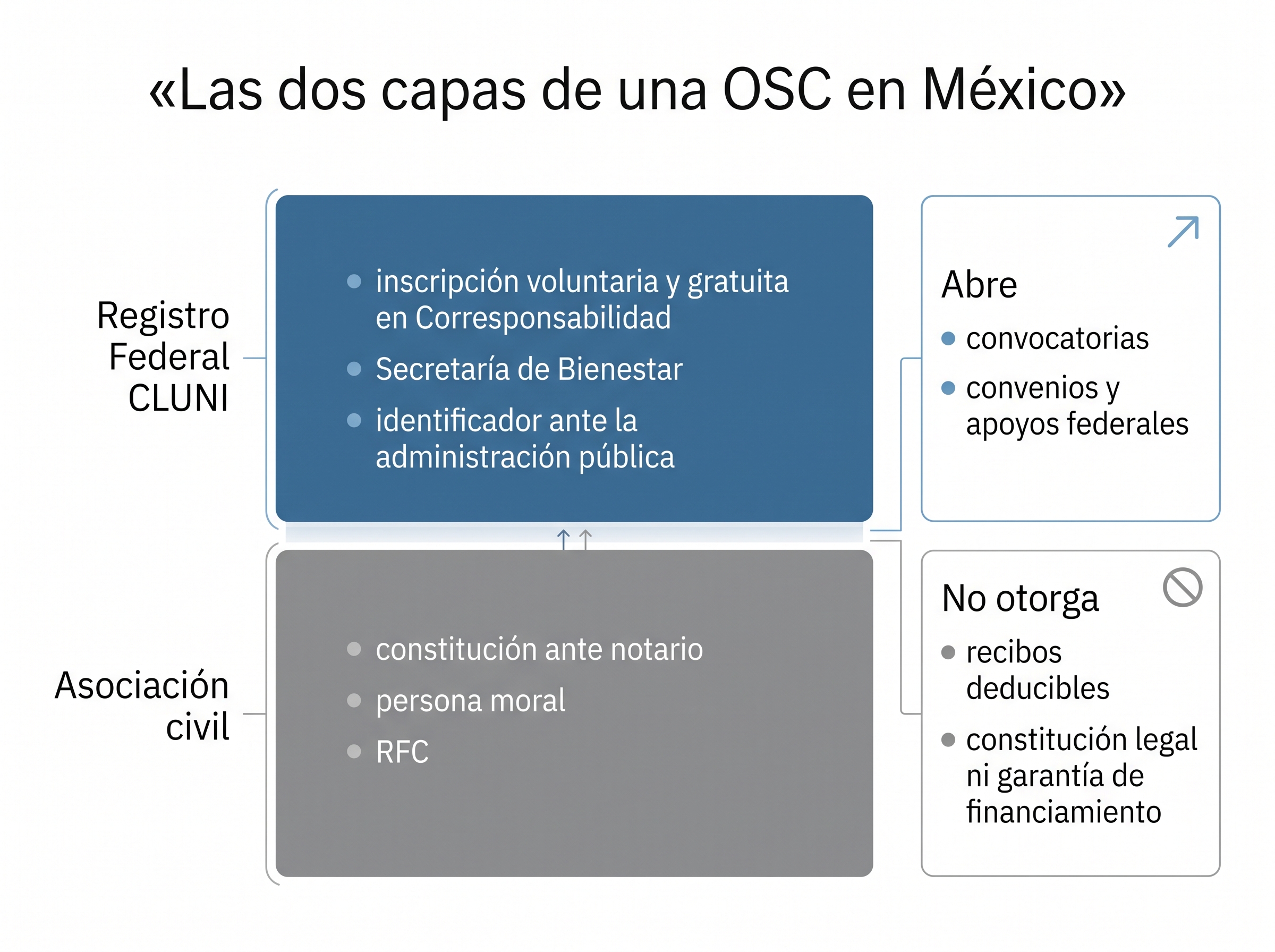
Applications are processed through Corresponsabilidad, the online platform run by Mexico’s Ministry of Welfare [1][3]. The law establishing the registry has six chapters. Chapter III covers the responsible authorities and the measures they can take to support CSOs [6].
Registration is voluntary and free, but organizations must register to qualify for federal government support and incentives [6]. Here are two examples.
- The 2026 PAICE call for proposals asks applicants to provide their registration certificate showing their CLUNI, plus a brief résumé documenting at least two years of experience promoting cultural activities [2].
- Grant program agreements require organizations to supply their CLUNI as proof of registration [7].
A CLUNI opens the door to government programs. Funding and tax benefits each have their own requirements.
A CLUNI and authorized donee status serve different purposes
Holding a CLUNI does not entitle an organization to issue receipts for tax-deductible donations. The Mexican Tax Administration Service (SAT) grants authorized donee status under tax law. A CLUNI identifies a CSO and confirms that it is registered [9][10].
| Feature | CLUNI | Authorized donee status |
|---|---|---|
| Responsible authority | Federal Registry of CSOs / Ministry of Welfare | SAT |
| Purpose | Register and identify a CSO | Allow donors to deduct certain contributions |
| Is this a tax designation? | No | Yes |
| Can the organization issue receipts for tax-deductible donations? | No | Yes, while the authorization is valid |
| Does it help an organization apply to public programs? | Yes, depending on the program rules | Not necessarily |
| Does it replace the other procedure? | No | No |
The numbers illustrate the difference. Using Federal Registry data as of January 28, 2025, the Mexican Center for Philanthropy (Cemefi) estimated that Mexico had 49,187 civil society organizations in 2025, of which 45,269 held a CLUNI. The Center for Public Finance Studies (CEFP) of Mexico’s Chamber of Deputies reported 10,507 authorized donees in 2025. The groups overlap, but most organizations with a CLUNI cannot issue receipts for tax-deductible donations.
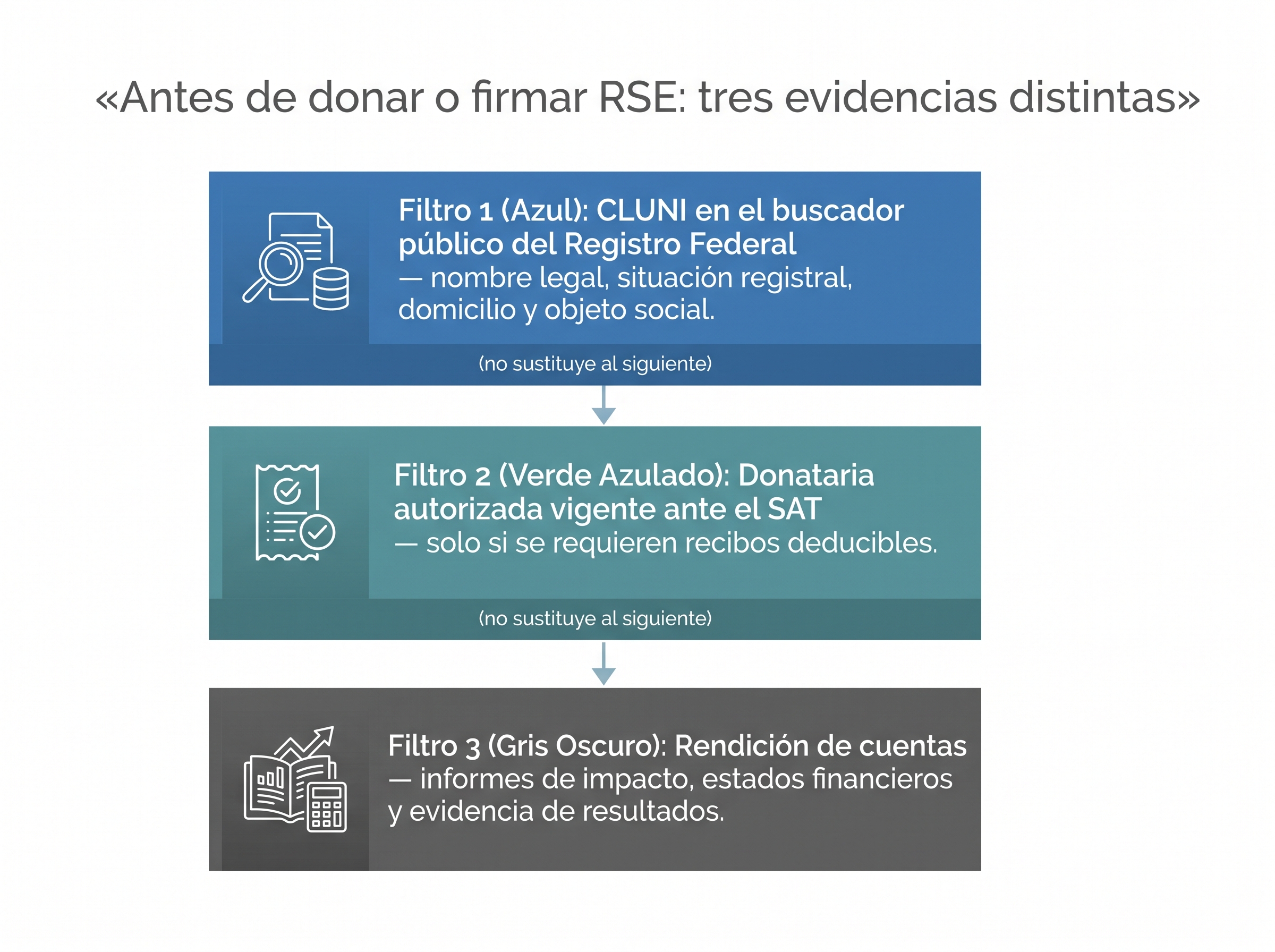
If you manage CSR, check three things separately: the organization’s CLUNI, its current tax authorization, and the way it accounts for its work. Each check calls for different evidence.
Mexico’s 2025 tax rules changed how the SAT treats a CLUNI
Under Mexico’s 2025 miscellaneous tax rules (Resolución Miscelánea Fiscal, or RMF), certain authorized donees can no longer use their CLUNI to prove to the SAT that they carry out their stated activities. They now use a certificate of activities (Constancia de Acreditación de Actividades), valid for three years. The change appears in Rule 3.10.1.6 of the 2025 RMF, published in the Federal Official Gazette on December 30, 2024. Its annexes were published on January 3, 2025.
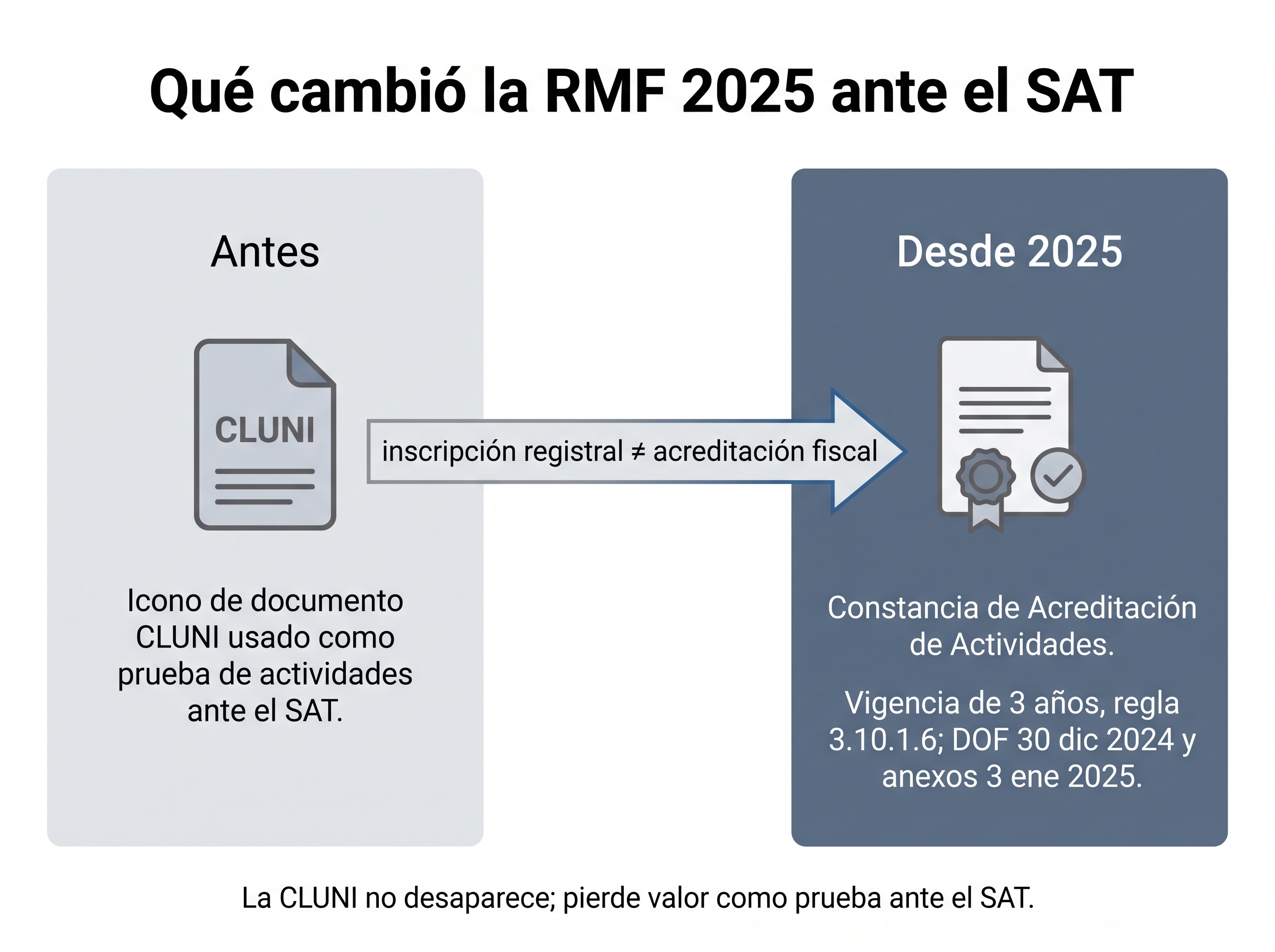
An entry in a registry proves that a CSO is registered. The SAT is looking for evidence of something different: that the organization actually carries out the activities for which it received authorized donee status.
If your organization has relied on its CLUNI for this purpose, take the following steps.
- Review your tax records.
- Check whether the SAT requires proof of your activities.
- Apply for the appropriate certificate or update your existing one.
- Keep evidence of projects, the people they serve, and their results.
- Schedule renewal before the three-year period ends.
The CLUNI remains part of the framework for civil society organizations. What has changed is its value as evidence for tax purposes. If your organization relies on tax-deductible donations, seek professional tax advice.
Applying for the CLUNI online and responding to requests for corrections
You can apply for a CLUNI free of charge on the Corresponsabilidad platform. Create a user account, enter your organization’s details, and upload the required documents [1][3]. Individuals as well as legal entities operating as CSOs may need to request it [4].
The application has six steps.
- Create an account at
corresponsabilidad.bienestar.gob.mxusing your organization’s federal taxpayer ID (RFC) [1]. - Enter the legal details, address, representatives, and the organization’s stated purpose.
- Upload the documents required under the LFFAROSC.
- Check that the articles of incorporation and stated purpose match the activities you declare.
- Submit your application and keep the reference number.
- Download the certificate once your application is approved. If the authority requests corrections, respond to its notice of deficiencies (Oficio de Insuficiencia).
Our main recommendation is to write a statement of purpose that matches the activities supported under Article 5 of the law. These include protecting the environment.
Three common problems to watch for
- A vague statement of purpose. This often prompts a request for clarification.
- Ignoring a notice of deficiencies. Your application could lapse.
- Paying an intermediary. The process is free and entirely online. Nobody should charge you for it.
The annual report keeps your registration in good standing
Each January, registered CSOs must submit a report to the Comisión de Fomento describing their activities and how they fulfilled their stated purposes [8]. Failing to file puts the registration at risk.
⚠️ Keep track of two deadlines
The report to the Comisión de Fomento is due every January and keeps the organization’s CLUNI registration in good standing. The SAT’s certificate of activities is valid for three years and applies only to authorized donees. Confusing the two deadlines can put either your registration or your tax authorization at risk.
Obtaining a CLUNI is the start of an ongoing relationship with the registry. To meet the January deadline, start preparing in December.
- Set an internal calendar and assign responsibility for each task.
- Gather evidence of projects and the people they serve.
- Collect financial and operational reports.
- Update the details of the organization’s representatives and its address.
- Make sure you receive an acknowledgment of filing.
If you run an environmental organization, use the report to show how each reforestation, restoration, or agroforestry activity relates to your goals, the communities it serves, and its documented results. That report can be one of your clearest demonstrations of transparency.
Checking a CSO before donating or forming a partnership
You can look up a CSO by its legal name or CLUNI in the Federal Registry’s public information system. With more than 45,000 organizations holding a CLUNI, according to Cemefi’s estimate, this is a quick first check.
The search takes only a few minutes.
- Open the Federal Registry’s public search tool.
- Search by legal name or CLUNI.
- Compare the public record with the details the organization gave you: its name, CLUNI, registration status, address, and stated purpose.
Checking the registry is the first step. Follow up by looking at impact reports, financial statements, and evidence of results.
We invite you to check Global Lemon in the same way. Explore our environmental projects and compare the public record with what we document in the field, including our work in Santa Rita Tlahuapan.
As one voice in the sector puts it: “Strengthening the CLUNI, diversifying funding, and building partnerships are essential to keeping every cause moving forward”.
Frequently asked questions
Where do you apply for a CLUNI?
Apply online through the Mexican government’s Corresponsabilidad platform. The organization creates an account, enters its information, uploads the documents, and submits the application [3]. Applying is free. Before starting, check that the information in your articles of incorporation, taxpayer registration (RFC), address and statement of purpose is consistent.
Does a CLUNI expire?
It has no set expiration date, but the registration must be kept up to date. The organization must update its details and file its annual report in January [8]. Authorized donees must provide the SAT with a certificate of activities that is valid for three years.
What is “Cluny”?
It is an alternative spelling of “CLUNI.” In Mexico, CLUNI stands for Clave Única de Inscripción al Registro Federal de las Organizaciones de la Sociedad Civil, the unique registration number in the Federal Registry of Civil Society Organizations [4]. It identifies a registered CSO. It does not authorize the organization to issue receipts for tax-deductible donations.
Where can I check whether a civil association is registered?
Use the public search tool in the Federal Registry of CSOs’ information system. Search by name or CLUNI and compare the official information with the organization’s projects and reports. For corporate donations, include this check in a broader due diligence review.
How do I register a nonprofit foundation?
First incorporate the organization, then apply to register it as a CSO [1]. The process generally requires articles of incorporation, an RFC, representatives, a statement of purpose, and organizational documents. Obtaining a CLUNI is separate from incorporating a legal entity and securing SAT tax authorization.
What are ten examples of civil associations in Mexico?
There is no official list of the top ten. To build a list you can stand behind, select organizations from the official registry and check each one’s CLUNI, stated purpose, tax status, transparency, and results. Explain the criteria you used.
Limitations and professional guidance
A CLUNI proves that an organization is registered. On its own it does not establish impact, solvency, transparency, or authorization to issue receipts for tax-deductible donations. Rules change, as the 2025 RMF illustrates, and requirements depend on the procedure. This article provides general information and is not legal or tax advice. Check current information on the official platforms and consult a professional before applying for authorized donee status, obtaining a certificate of activities, or negotiating a public agreement.
Conclusion
The CLUNI is an important part of Mexico’s framework for civil society organizations. It identifies a CSO in the Federal Registry and opens access to calls for proposals and government support programs [6]. It does not confer authorized donee status or allow an organization to issue receipts for tax-deductible donations.
Your next steps depend on your role.
- If you run a CSO, apply for a CLUNI free of charge and file your report every January. If you are an authorized donee, also check your certificate of activities.
- If you donate or manage CSR, look up the CLUNI in the official registry, verify SAT authorization separately, and ask for evidence of impact.
Ready to turn your sustainability goals into results you can see and measure? Explore our projects, read the stories that inspire us and, when you’re ready, donate here. Let’s do it together!
About the authors We’re the Global Lemon team. We write about the work we know best, explaining it as clearly as we can so you can make informed decisions.
Transparency statement This article draws on the cited sources, including government authorities and documents, sector specialists, and civil society organizations. Social media sources provide context for questions and experiences. Consult the official rules for regulatory requirements.
References
[1] How to form a civil association in Mexico, step by step | Mexico
[2] PAICE | 2026 call for proposals
[3] Steps for creating a civil society organization in Mexico
[4] State Registry of Procedures and Services
[5] Comisión de Fomento | Ministry of Foreign Affairs | Government of Mexico | gob.mx
[6] What is the Federal Registry of CSOs? | RSE y Sostenibilidad
[7] Operating rules for program S268, 2026 (PDF)
[8] What commitments does a CSO take on when it obtains a CLUNI?
[9] What a CLUNI is and how to apply in Mexico | Fundación Catzi