Original Ideas for Corporate Events with a Purpose
Plan a corporate event in Mexico in 2026 with a practical guide to budgeting, safety and measuring the environmental impact of your event.
By Global Lemon Team ·

Quick answer: Corporate events bring teams, clients and partners together to share information, build relationships, recognize achievements or mobilize people around a goal. In Mexico, organizing one well takes five things: clear objectives, an itemized budget, logistics, civil protection and a way to measure results. When the event includes reforestation with native species and a record of where trees are planted, it can also support corporate social responsibility (CSR), provide evidence for environmental, social and governance (ESG) reports, and give the team an experience it remembers.
Why corporate events need to show what they achieve
The venue, the catering and the headcount tell you little about whether a corporate event succeeded. Three questions tell you more. Did it meet a business objective? Did it look after the people who took part? Did it produce results you can verify?
The meetings industry is a significant part of Mexico’s economy. The Consejo Mexicano de la Industria de Reuniones represents congresses, conventions, exhibitions, trade fairs, business meetings, incentive travel and destination weddings. Its members also include organizers, hotels, venues and suppliers [4]. Industry figures attributed to the Consejo Nacional de la Industria de Reuniones (CNIR) put the annual economic impact at about MXN 443 billion, or roughly 1.84% of GDP. Treat those figures as industry estimates rather than audited official statistics.
📊 An industry benchmark
The estimated annual economic impact of about MXN 443 billion gives a sense of the size of the meetings industry. It cannot justify a particular company’s spending. For your own business case, use your expected attendance, budget items and comparable quotes.
Different departments look for different things in the same event:
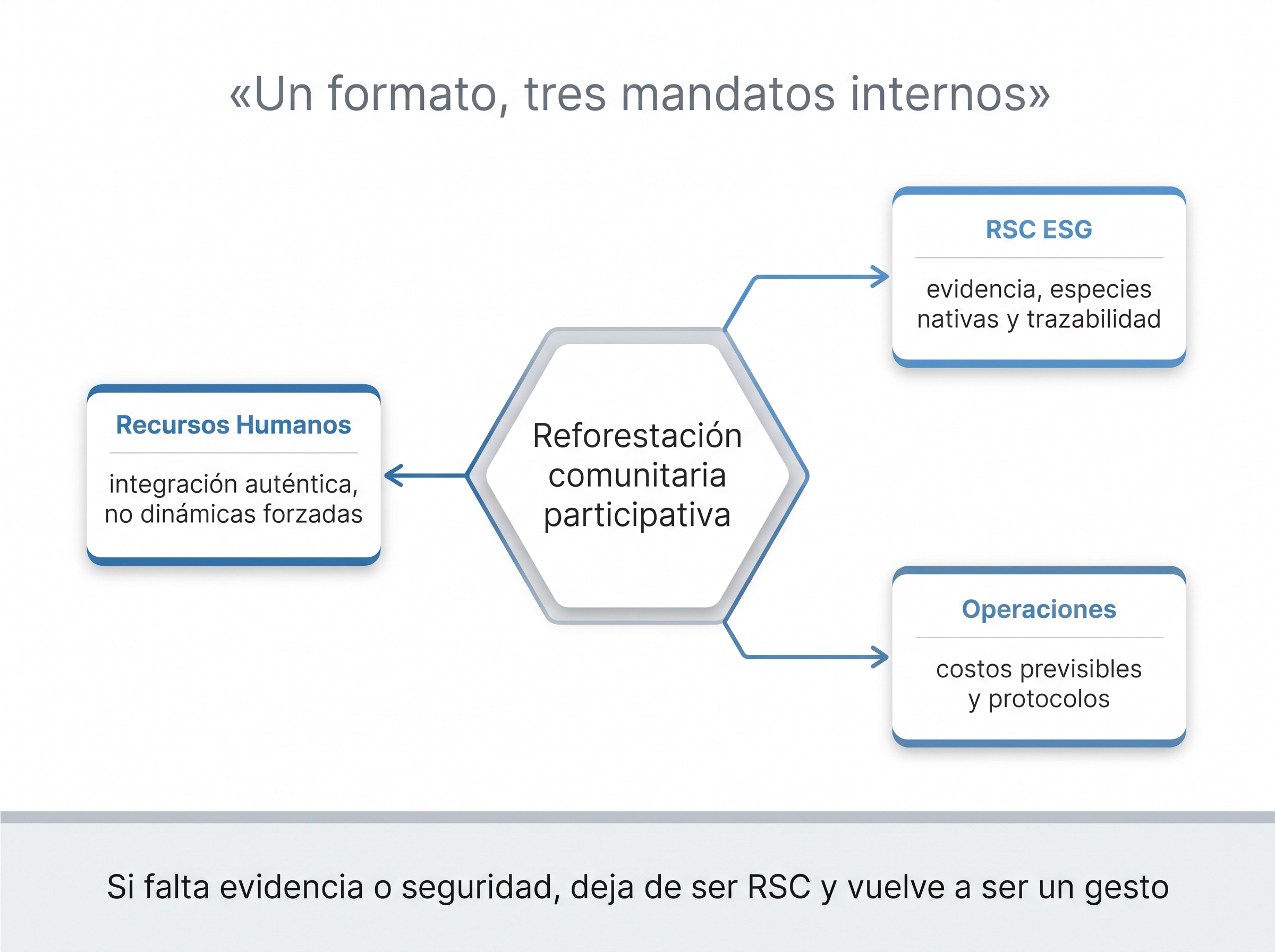
- Human Resources wants people to make real connections.
- CSR and ESG teams need evidence and traceability.
- Operations wants predictable costs and clear procedures.
A hands-on community reforestation event can meet all three needs. This guide covers planning, costs, civil protection, sustainability and measurement. A worthwhile environmental purpose and a well-run event can go hand in hand.
Where event professionals agree
Event organizers return to three ideas: work behind the scenes shapes the outcome, participants expect a sense of purpose, and what endures is the memory.
Turavion MICE puts it this way: “The difference between a successful event and one that runs into problems is rarely on stage. It’s in everything that happens behind it.” The company recommends putting planning and operations in the hands of one team.
Paradores de Turismo asks, “What if your next corporate event could also make a positive impact?” The Sociedad Mexicana de Parrilleros observes, “The best corporate events are the ones the team remembers long after they end.”
Reforestation as a corporate event with measurable environmental impact
Planting can be more than a symbolic gesture. For that to happen, the event needs ESG objectives, suitable species, technical guidance and follow-up after planting day.
How to plan a planting day whose results can be verified
Compared with a conventional team-building event, planting brings hands-on participation, environmental learning, a connection with the community and evidence for CSR reporting. For more, see our guide to outdoor team building through tree planting.
Follow these five steps:
- Define the objective. It could be team building, volunteering, offsetting, education or putting an ESG initiative into practice.
- Choose the site, the community partner and the species. Use species native to the ecosystem.
- Plan a guided activity. Organize teams, include Planting challenges, brief everyone on safety and designate a leader for each crew.
- Record who took part, which trees were planted and where. Global Lemon records the location of each tree, making it possible to verify the work done that day.
- Deliver a report. Include participation, trees, site, project and plans for follow-up.
Environmental volunteering can grow in scale. According to Yahoo Vida y Estilo, Cox México’s program set a target of 12,000 trees across six states. Reforestation at corporate events has become one concrete way for businesses to express their social responsibility [8].
Even so, planting trees is not the same as achieving carbon neutrality. Start by measuring and reducing emissions. Address the remainder through offsets as part of a broader plan [9][10].
⚠️ Planting trees does not erase an event’s footprint
A report documenting the trees, site and planting locations provides evidence of social and environmental activity. It does not demonstrate carbon neutrality. First measure the impacts of travel, energy, accommodation, food and waste. Reduce them, then address residual emissions, making the boundaries and methodology clear.
How traditional events and reforestation events compare
| Criterion | Traditional event | Event with reforestation |
|---|---|---|
| Goal | Networking, training or celebration | Team building, environmental purpose and CSR |
| Participation | Passive | Active, collaborative and outdoors |
| Evidence | Survey and photographs | Trees, site, species, planting locations and report |
| Connection to ESG | Indirect | Can be linked to social and environmental goals |
| What people remember | Depends on the experience | Something the team did together and can point to |
Planning for environmental impact starts with the budget. It takes more than adding a green touch at the end.
What it costs to organize a corporate event in Mexico in 2026
Cost varies by format, city, attendance and production requirements. The method for managing it stays the same: budget by line item, set aside a contingency from day one and reconcile the accounts at the end [6][7].
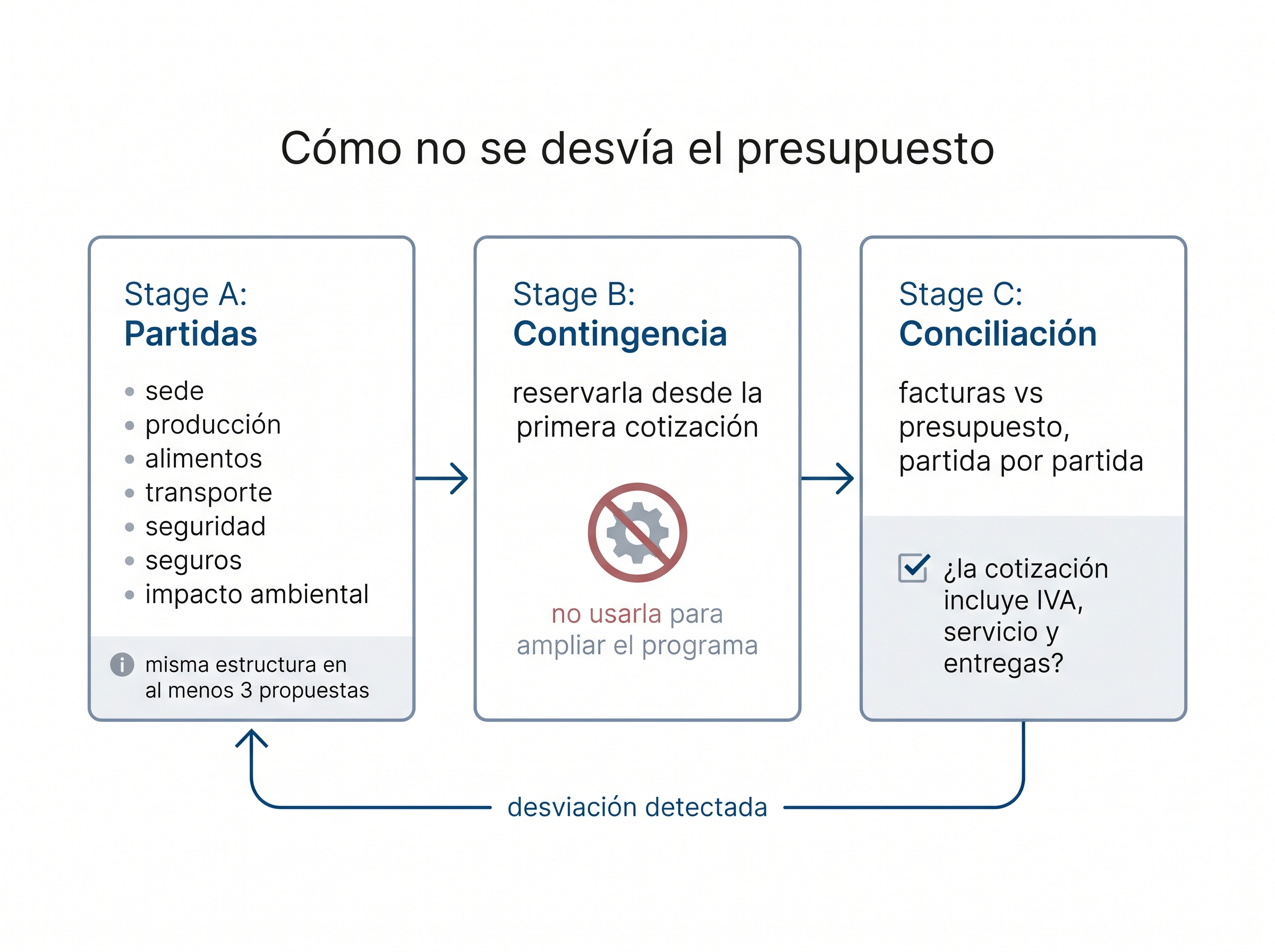
Building an itemized budget and tracking variances
- Define the purpose, audience and format.
- Set a spending ceiling and identify who approves each item.
- Obtain quotes for the venue, production, food, transport, security, insurance and environmental activities.
- Set aside a contingency for service charges, VAT, deliveries and insurance [6].
- Compare invoices with the budget, line by line [7].
Ask each supplier to state whether its quote includes VAT. As a market benchmark, MercadoSeguridad.mx lists rates of MXN 800 to MXN 2,000 per guard for an 8- to 12-hour shift. In Tijuana, the range rises to MXN 1,000 to MXN 2,600. These are indicative figures. The final price depends on the guard’s qualifications, the level of risk and the length of the shift.
Budget line items and how to estimate them
| Item | Benchmark | How to budget |
|---|---|---|
| Agency | Depends on scope, city and season | Get the scope, deliverables and exclusions in writing |
| Private security | MXN 800–2,000 per guard per shift | Use attendance, risk and shift length |
| Security in Tijuana | MXN 1,000–2,600 per guard per shift | Consider local rates and travel |
| Contingency | Set it aside from the first quote [6] | Reserve it for unexpected costs, not new activities |
| Taxes and charges | VAT, service charges, deliveries and insurance [6] | Confirm which ones the quote includes |
| Environmental activity | Site, logistics, facilitation and traceability | Request a per-participant breakdown and supporting evidence |
Practical tip: ask for at least three proposals with the same line items. That lets you compare equivalent prices instead of just the totals.
Civil protection and safety for corporate events in Mexico
Before you sign contracts, assess the risks and confirm local requirements. This is particularly important for large or outdoor events and those involving transport, food, music, temporary structures or physical activity.
Checks to make before confirming suppliers
The PROY-NOM-011-SSPC-2025 draft standard sets out minimum civil protection requirements for shows and large-scale events [3]. Notice of the public consultation appeared in Mexico’s Diario Oficial de la Federación on September 17, 2025. Responses to the comments received were published later.
Bear in mind that this is a draft Mexican Official Standard (NOM). The final requirements for your event depend on the municipality, state, attendance, venue and activity.
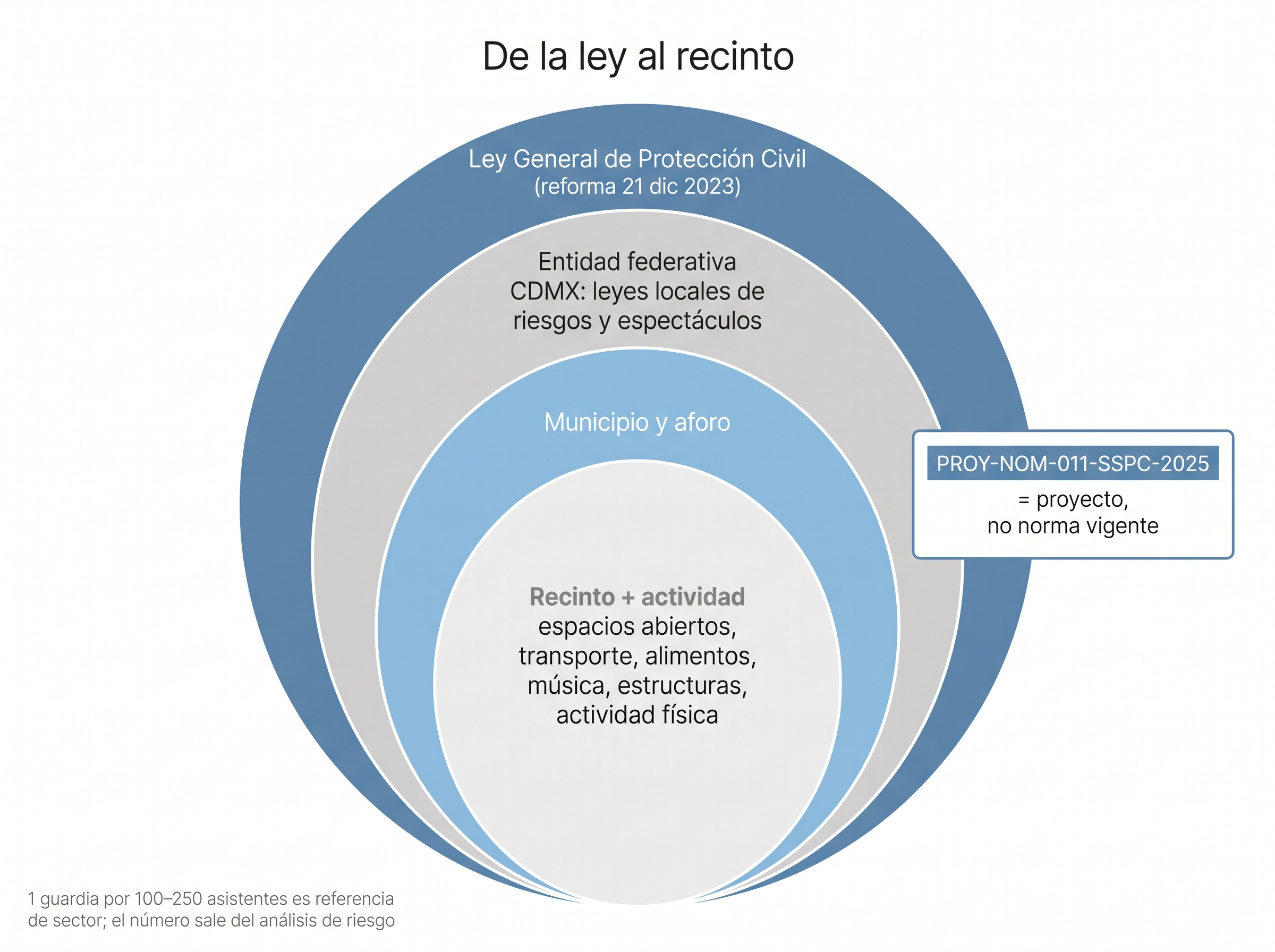
The general framework is Mexico’s Ley General de Protección Civil, which the article identifies as last amended on December 21, 2023. In Mexico City, the Ley de Gestión Integral de Riesgos y Protección Civil and the Ley para la Celebración de Espectáculos Públicos also apply [5].
Before confirming suppliers, check the following:
- Permits from the venue and the relevant authority.
- A civil protection plan.
- A risk assessment and evacuation routes.
- Security and first aid.
- An insurance policy, where applicable.
- A contact list for those in charge and for suppliers.
- Procedures for weather, transport, medical incidents and operational changes.
Start the approval process with the civil protection authorities at least 30 days in advance [5]. One staffing benchmark used in the industry is one guard for every 100 to 250 attendees. Your event’s risk assessment should determine the actual number.
Note: this information does not replace advice from the civil protection authority, the venue or a qualified safety specialist.
Measuring sustainability at corporate events: ISO 20121, reductions and offsets
Removing plastics is only one step. A sustainable event requires managing its environmental, social and economic impacts before, during and after it takes place.
Measure, reduce, offset, verify and communicate
The ISO 20121 standard describes a sustainability management system for designing, organizing and running events. It aims to minimize adverse impacts and maximize benefits [1]. In practice, the article describes five phases:
- Measure: travel, energy, accommodation, food, materials and waste.
- Reduce: choose nearby venues, shared transport, local suppliers and reusable materials.
- Offset: do this only after making reductions, never as a substitute for them [10].
- Certify or verify: use sustainable-event and carbon-neutrality programs that include measurement and offsetting [9].
- Communicate: explain the methodology, boundaries, results and evidence, avoiding absolute promises.
These steps should work together throughout the event [2]. Planting native species with community partners and following up afterward can make a meaningful contribution within that approach. Explore Global Lemon’s restoration projects.
Frequently asked questions about corporate events
What types of corporate events are there?
They can be grouped by purpose: sharing information, training, selling, recognizing achievements or bringing people together. Common formats include congresses, conventions, trade fairs, business meetings, incentive trips, launches and team building [4]. Reforestation can bring teams together, create a volunteering opportunity or put an ESG initiative into practice.
What are the four main categories of business events?
Internal, commercial, institutional and social or environmental impact events. One event can combine several categories, provided it has defined measures of success for each.
What are the five steps in organizing a corporate event?
Set objectives, prepare the budget, choose the format and suppliers, run the event using agreed procedures, and evaluate it. Assign each step an owner, a date and a criterion for approval. At the end, reconcile invoices and document the impact [6][7].
How much does an event organizer charge in Mexico?
There is no single rate. Ask for comparable proposals that separate fees, production, logistics, taxes and insurance. Confirm which services are excluded.
What procedures are required for large events?
They depend on risk, capacity, the venue and local regulations. They usually cover civil protection, evacuation, medical care, security, insurance and named people in charge. PROY-NOM-011-SSPC-2025 provides a reference, but is still a draft [3][5].
What is a sustainable corporate event?
It is an event designed to reduce negative impacts and increase environmental, social and economic benefits. Putting that into practice takes measurement, responsible suppliers and transparent communication. ISO 20121 provides a reference framework [1].
Limits, alternatives and when to seek specialist support
Seek specialist help for events involving large crowds, children, natural areas, group transport, stages, temporary structures, food or alcohol.
If planting in person is impractical, consider these alternatives:
- Sponsor trees whose locations can be traced.
- Host an environmental workshop.
- Hold a hybrid event.
- Volunteer for maintenance work.
The Bosque de la Primavera project offers specific ways to take part.
Planning events that leave participants energized and produce results they can verify
Successful corporate events bring objectives, budgeting, logistics, safety and evaluation together. Before your next event, check three things:
- An itemized budget, with a contingency included from the first quote.
- Permits and civil protection approvals, with the process started at least 30 days in advance.
- An impact planthat follows the sequence of measuring, reducing and offsetting, and produces a verifiable report.
⚠️ Check the civil protection approval timetable before confirming suppliers
Thirty days is the minimum lead time the article gives for filing, not the time to start thinking about permits. The venue, municipality and risk assessment carry more weight than any quoted rate for guards. This guide cannot replace advice from the authorities or a safety specialist.
Operational decisions and transparent communication demonstrate sustainability. A claim to have offset everything needs a methodology to support it.
Reforestation offers something few event formats can: the team does the work together, and the result can be documented through the trees, their locations, the project and the community involved. If you’re looking to bring people together around a purpose, organize a Planting tournament with Global Lemon. Your next event could leave a forest behind.
About the author
Global Lemon Team
We are the Global Lemon team. We write about the work we know best, aiming to explain it clearly and help you make decisions with reliable information.
Transparency statement
This article draws on institutional, industry and journalistic sources, and on LinkedIn posts by professionals. Sources include COMIR, Mexico’s Diario Oficial de la Federación, MercadoSeguridad.mx, SUSTY, Bosquia and events industry specialists. The cost ranges are indicative estimates. They are not binding quotes. Confirm civil protection requirements with the local authority and the venue.
References
[1] What is ISO 20121? Sustainable event management | Manglai
[2] Event sustainability: a complete practical guide for 2026
[4] COMIR – Consejo Mexicano de la Industria de Reuniones
[5] Security at large events: procedures, permits and guards | MercadoSeguridad.mx
[6] Ten strategic steps for planning corporate events | Naboo
[7] The definitive guide to corporate event planning | Kombo
[8] Transform your events through corporate reforestation