How to Deduct Charitable Donations in Mexico
A guide to tax-deductible giving in Mexico in 2026, including eligibility requirements, deduction limits, CFDI tax receipts and how to verify a charity’s status.
By Global Lemon Team ·
Updated November 2026 · 8-minute read
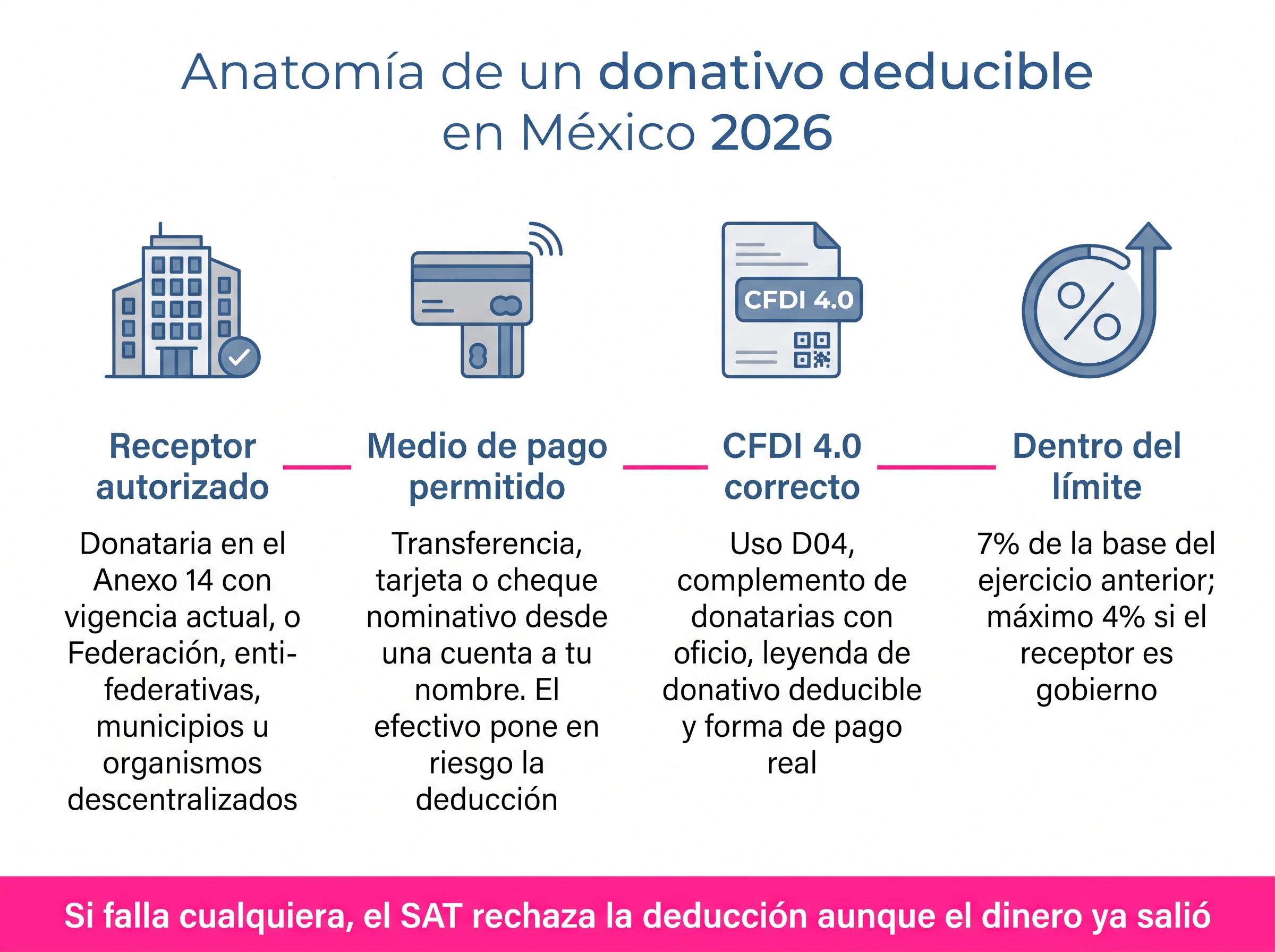
Quick answer: In Mexico, a donation may be deductible if you receive nothing in return, give to an authorized recipient, the federal government, a state, a municipality or a decentralized public body, pay by a permitted method, and obtain the correct electronic tax receipt (CFDI) [1]. For individuals, the general cap is 7% of the previous tax year’s cumulative taxable income [6]; for legal entities, the calculation is based on taxable profit under Article 27 of Mexico’s Income Tax Law (LISR) [7]. Before donating, check current authorization in Annex 14 and keep your documentation.
Donating to an environmental cause can help restore forests and strengthen communities. The tax benefit is conditional: if the recipient, amount, payment method or CFDI fails to meet the requirements, the Mexican tax authority (SAT) can reject the deduction after the funds have left your account.
This guide covers the 2026 framework, including the SAT, LISR, CFDI 4.0 and Annex 14, for individual donors and corporate social responsibility teams. Impact is a separate consideration. Ask which project you are funding and how the project reports its results.
What sector specialists point out
Authorization to receive tax-deductible donations is renewed annually. It requires transparency and continuity in the authorized activities [5]. The Centro Mexicano para la Filantropía (Cemefi) emphasizes the importance of maintaining this status, because losing it can cut off donations overnight.
The Colegio de Contadores Públicos de México notes that setting up an authorized recipient entails legal, tax and administrative requirements and that 12 categories of activity can qualify for tax-deductible donations [10]. Journalist Azucena Uresti reported on X on SAT revocations. Three problems recur in the cases she describes: unmet requirements, insufficient evidence of qualifying activities (for example, evidence of the scientific nature of a research project), and lack of familiarity with renewal procedures.
These sources do not replace the law. They illustrate why checking before transferring funds matters.
How can you verify a recipient’s authorization in 2026?
Check for a current authorization in Annex 14. The SAT publishes the list in the Miscellaneous Tax Resolution (RMF) and updates it as entries are added, removed or amended [4]. Check before donating and save the evidence with your CFDI.
Five steps to verify authorization
- Go to the SAT’s authorized donation recipients site and find Annex 14 to the 2026 RMF.
- Search by legal name or taxpayer identification number (RFC) rather than by trading name.
- Check the authorized category and activity.
- Look for expiry, cancellation, suspension or revocation.
- Save a dated screenshot and match the RFC to the one on the CFDI.
Authorization does not remain valid if the organization’s RFC registration has been cancelled or suspended [5]. An earlier listing does not prove current authorization. Before paying, check six details: legal name, RFC, authorized activity, current status, recipient bank account and CFDI.
Donation CFDI: seven checks before claiming a deduction
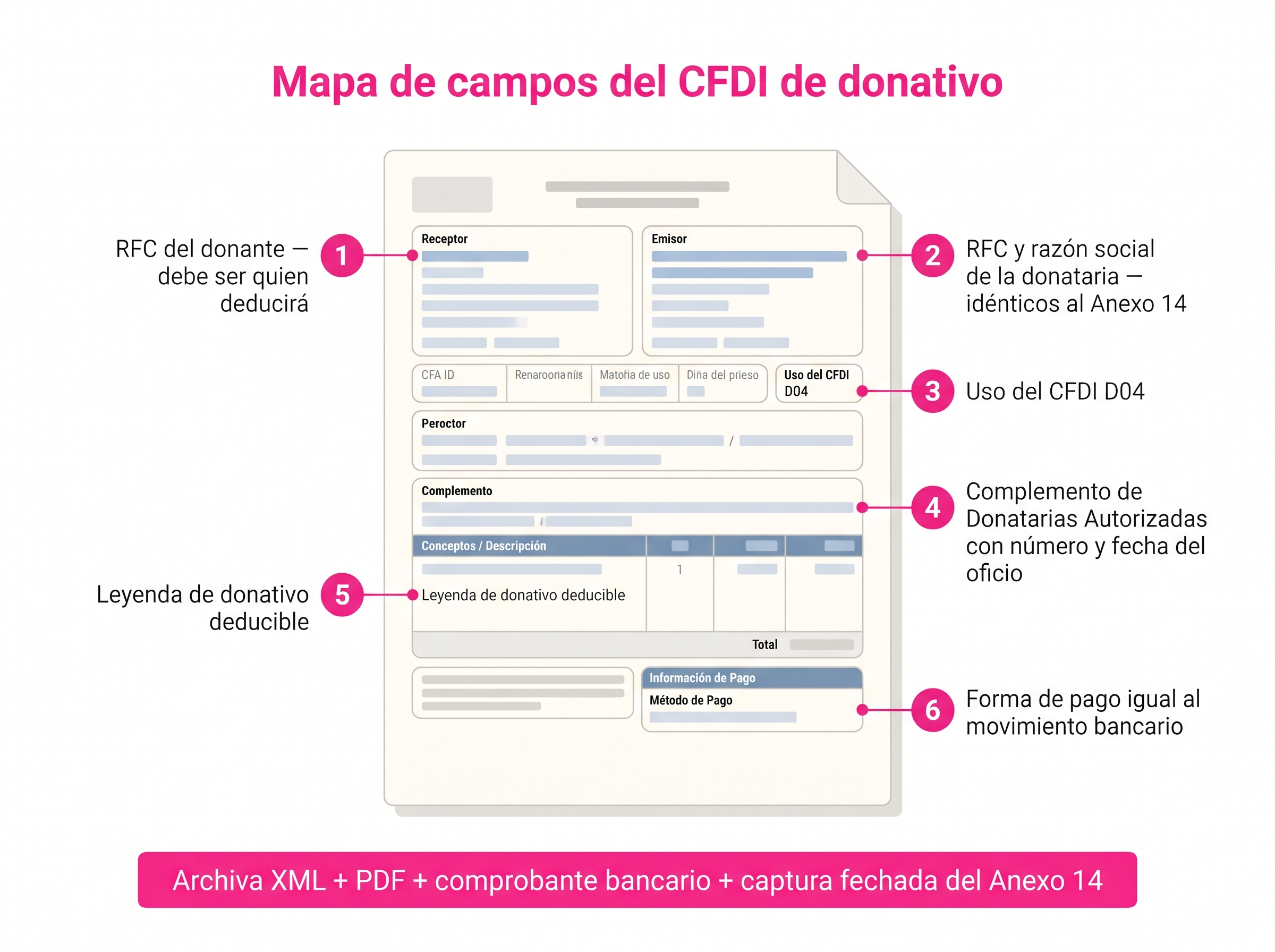
An invoice alone is insufficient. Mexico’s Federal Tax Code requires the receipt to state that it covers a tax-deductible donation and give the authorization letter’s number and date [8], identify both parties and reflect the actual purpose and method of payment.
Seven-point checklist
- Donor’s RFC: it must match the taxpayer claiming the deduction.
- Recipient’s RFC and legal name: check both against Annex 14.
- CFDI use code: D04 (donations) for individuals. For legal entities, confirm the use code with the accounting team.
- Authorized donation recipient supplement: number and date of the authorization or renewal letter [8].
- Deductible donation statement on the receipt.
- Payment method matching the method you actually used.
- Records to keep: the XML, a printed copy, bank payment confirmation and evidence of authorization.
Errors that invalidate the deduction
The wrong RFC, use code or tax regime on the CFDI invalidates the deduction [7]. Common errors include:
- A CFDI issued to a different person or company.
- A recipient without valid authorization.
- Payment in cash when it is not permitted.
- An in-kind donation recorded as a monetary donation.
- Claiming another deduction for goods already deducted.
The SAT states that payment must be made by transfer, card or a check payable to a named recipient, from an account in your name [6].
Donation deduction limits: examples for individuals, legal entities and contributions to government
The general cap is 7%. The base is cumulative taxable income for the previous tax year for individuals, or the previous tax year’s taxable profit for legal entities [2][6]. This is the maximum deductible from your tax base. It is not a refund.
| Taxpayer | Calculation base | Cap | Example |
|---|---|---|---|
| Individual | Previous tax year’s cumulative taxable income | 7 % | MXN $400,000 × 7% = MXN $28,000 |
| Legal entity | Previous tax year’s taxable profit | 7 % | MXN $2,000,000 × 7% = MXN $140,000 |
| Donation to government by an individual | Previous tax year’s cumulative taxable income | 4%, within the 7% total cap | MXN $400,000 × 4% = MXN $16,000 |
With MXN $400,000 in cumulative taxable income, you can deduct up to MXN $28,000. Of that total, no more than MXN $16,000 can go to government. To use the full deduction, at least MXN $12,000 would have to go to private authorized recipients.
The legal basis is Article 151 of the LISR for individuals and Article 27 for legal entities [2][7].
Cash and in-kind donations: when can they be deductible?
A cash payment of more than MXN $2,000 may make an expense nondeductible even with an invoice [7]. For donations, the SAT calls for banking methods [6]. Avoiding cash is the safest course. For an in-kind donation, document the asset and its value. The CFDI must describe it accurately.
| Type | What to check | Main risk |
|---|---|---|
| Monetary | Transfer, card or check payable to a named recipient, from an account in your name | Paying cash and keeping only a receipt |
| In kind | CFDI describing the asset and its documented value | Unsupported value or a vague description |
| Asset already deducted | Statement on the CFDI that the donation is nondeductible | Attempting to claim a second deduction |
If you donate an asset that you already deducted, the CFDI must state that it is nondeductible [8]. For inventory, assets or depreciated equipment, ask your accounting team to verify the treatment before you request the receipt.
What happens if the recipient’s authorization is revoked?
It stops issuing deductible receipts when the notice takes effect. Check authorization on the date of each contribution, even if you checked when you first began supporting the organization.
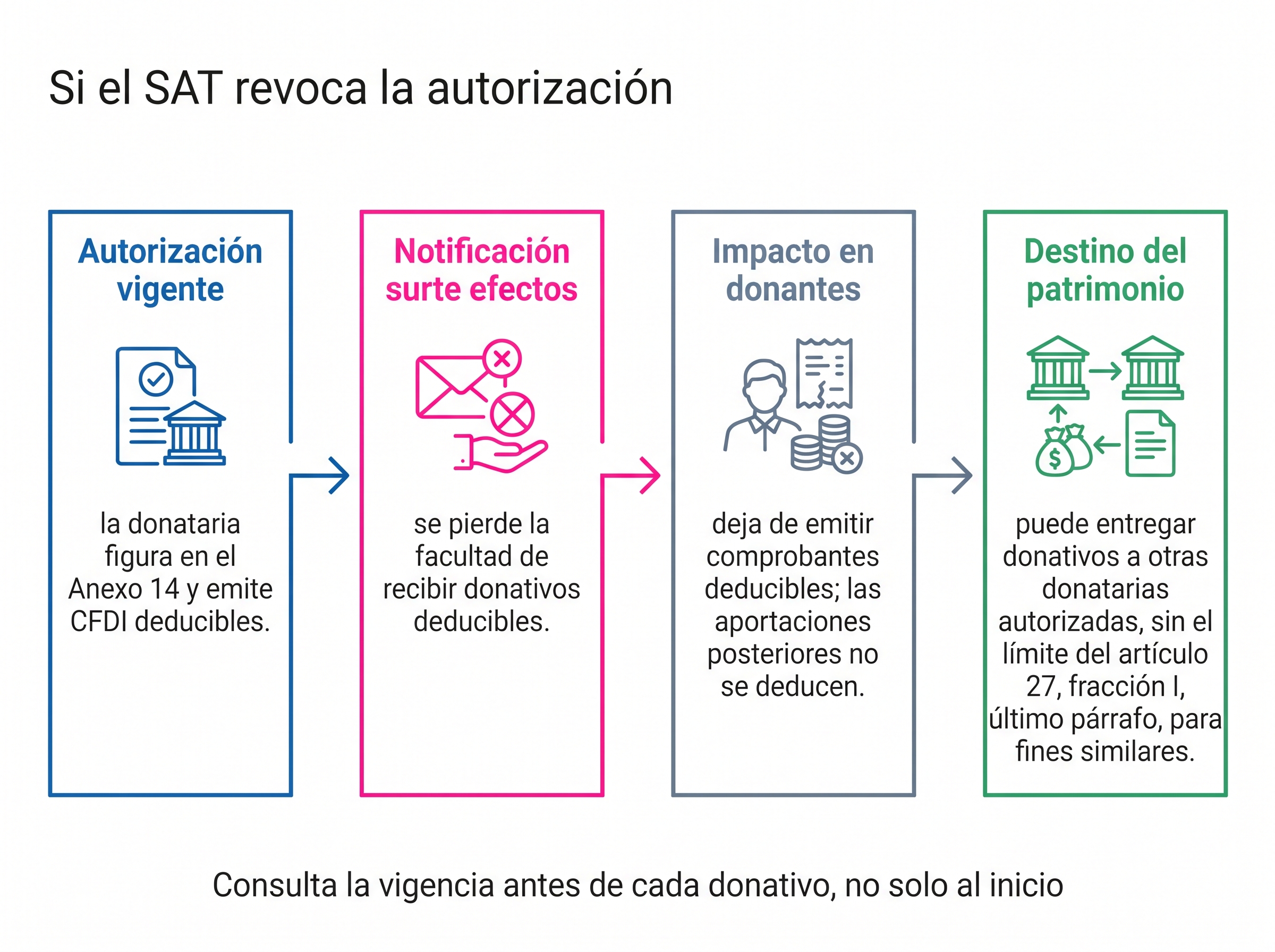
According to SAT information bulletin 07-2026, authorized recipients are civil society organizations or trusts permitted to receive tax-deductible donations. Losing that authority affects both the organization and its donors [3]. During the tax year, an organization whose authorization has been revoked may donate to other authorized recipients without the limit in the final paragraph of section I of Article 27 [2], so its assets can be used for similar purposes.
The 2026 RMF provides for loss of authorization if the authorized activities are not carried out or if the organization’s RFC registration is cancelled or suspended [5]. This is a compliance consideration and does not imply any finding about a particular organization.
How to protect the deduction
- Check authorization before each donation.
- Confirm that the authorized activity matches the cause.
- Retain the CFDI, XML, bank payment confirmation and evidence from Annex 14.
- Review the organization’s transparency report.
- In a business, coordinate the accounting, tax and CSR teams before launching the campaign.
Limitations, alternatives and professional guidance
The 7% cap and CFDI requirements are the starting point. Final eligibility depends on your tax regime and complete documentation [1][6]. This guide provides general information and does not replace advice from a public accountant.
Seek advice for in-kind donations, international transactions, large amounts or uncertainty about authorization. The SAT grants authorization after reviewing documentation, nonprofit activities and financial transparency [9].
Frequently asked questions
Which donations are deductible for individuals?
Donations made without receiving compensation or anything in return, to authorized recipients or public entities, with a valid CFDI and within the cap. The general cap is 7% of the previous tax year’s cumulative taxable income [1][6].
Which donations are tax-deductible?
Those that simultaneously satisfy the requirements for recipient, payment method, receipt and cap. Donating to an NGO alone is insufficient. The recipient needs current authorization or must be one of the public entities covered by the law [1].
What is the maximum donation deduction?
7% of the previous year’s tax base. Donations to government are capped at 4% within that 7% total. The base is cumulative taxable income for individuals or taxable profit for legal entities [2].
Can legal entities deduct donations?
Yes, if they meet Article 27 of the LISR and have the required documentation. Checks cover taxable profit, recipient status, payment method and CFDI [7].
Which rules apply to donation deductions in 2026?
The LISR rules, applied together with the 2026 RMF and the current Annex 14. Check that the authorization and receipt correspond to the correct tax year [5].
How do I report a donation to the SAT?
Check that the CFDI appears in the SAT portal and that the donation has been prefilled in your annual return. If you find errors, request a correction before filing.
Conclusion
A deductible donation combines impact with sound tax records. Check Annex 14, stay within the 7% cap (including the 4% maximum for government), use a bank payment method and save the XML.
Do this before December 31 so it counts for the tax year and your records are in order for the April return. If you represent a business, incorporate the process into your environmental CSRcontrols. Programs such as PLANTING make it easier for businesses to take part.
The cause matters too. Look at the project, its location and the impact report, as with the restoration of Bosque de la Primavera and other reforestation projects in Mexico. Want your contribution to take root? Make a donation to environmental restoration in Mexico and request your tax receipt.
About the author
Global Lemon Team — We write about environmental impact and tax compliance to help you make informed decisions.
Transparency statement
This article draws on official sources, specialist material and sector experience. Check current requirements when donating and filing. A mention of Global Lemon does not replace independent verification of its authorization, taxpayer details or the scope of each project.
References
[1] Donation deductions: requirements and key rules | IDC
[4] Annex 14, 2026: authorized donation recipients
[5] Miscellaneous Tax Resolution for 2026
[7] Article 27 of the LISR: requirements for authorized deductions
[8] CFDI 4.0 for authorized recipients: codes, supplements and checklist | El Contribuyente
[10] Key steps to establish an authorized donation recipient